What is Coffee Cabanas?
A Place to Hold Tolerant, Respectful, and Stimulating Discourse in-person

Coffee Cabanas is a meeting place for people to gain meaningful connect on the subject of philosophy. One day I wish to open a brick and mortor coffee shop dedicated to discussing Exism and other philosophies.
I wrote a book on my own take on the subject, called Exism, then realized I had no one to whom to discuss the ideas within the pages.
While this site is primarily driven to discuss the ideas of Exism, I wish to promote the better understanding of all philosophies.
The world seems to be less tolerate of idea sharing, and I want this site to be a place where people to discuss ideas in a relaxed and safe space.

Preface: Why Exism Now?
Philosophy has always helped humanity interpret reality, assign value, and determine action. But in our present era—marked by technological acceleration, narrative overload, and existential vertigo—the classical models we inherited are faltering. They were forged in a flatter world, one where existence was assumed to be linear, measurable, and singular. That world has cracked open.
Today, we face challenges that span across multiple, often invisible, dimensions: climate destabilization, algorithmic determinism, cultural dissonance, and identity crises not just of the self, but of truth itself. We no longer merely experience events—we are immersed in competing timelines, fragmentary perceptions, and contradictory frames of reference. In this multidimensional world, one-dimensional logic fails.
The urgency of this work is sharpened by the tools we now wield. Artificial intelligence, global data flows, and algorithmic governance are not merely technologies—they are accelerators of dimensional complexity. They act within Space, Perception, and Change, but often incompletely, omitting key axes of valuation or alignment. Without a framework like Exism, such systems risk amplifying the very fractures they aim to solve. To think clearly in this century requires not just speed, but structural completeness.
Exism is not a prescriptive belief system, but a method for the measurement of belief systems. It is an architectural model of thought—a toolset to navigate reality as it truly is: layered, directional, interactive, and observer-dependent. It asserts that existence unfolds within a Nine-Dimensional Matrix composed of three triads: Space, Perception, and Change. In daily life, these triads are always present: Space is where you are and what surrounds you, Perception is how you see and value it, and Change is how it shifts over time—together forming the full frame of reality. Each triad can be measured with distinct, measurable dimensions. This structure enables us to model not just what is, but how we relate to it, and how it evolves through our attention, agency, and alignment.
Exism contends that truth must be measured relative to the observer’s dimensional position—and that this measurement must be bounded, coherent, and ethically aware.
Starting this work felt like asking, “Where does a Möbius Strip begin?” The answer is not a place, but a decision: wherever the observer chooses to begin. And so we begin here, not with how we perform the measurements, but with a definition and the assumptions Exism used to coherently function. What is Exism? Let us begin.
Exism (noun)
Exism (noun) Pronunciation: /ˈɛk.sɪ.zəm/ A philosophical framework asserting that all recognizable being arises within a nine-dimensional matrix (Ξ) composed of three interwoven triads: Space, Perception, and Change. Each triad contains three measurable dimensions, forming the structure by which consciousness can bound, evaluate, and act upon the observable world. In Exism, existence is the unbounded domain within which all measurement becomes possible—but is not itself measurable in totality. Consciousness is the bounded configuration of collective experience, constructed through interactions across Cartesian space, while Spirit is the directional construct of resonant orientation formed through alignment across polar fields. Exism holds that reality is not fixed or singular, but structurable—shaped by the position, perception, and agency of observers. Each observer participates in reality’s unfolding by aligning—or misaligning—across these nine dimensions. Exism does not seek metaphysical absolutes. It offers a bounded framework for navigating meaning, contradiction, transformation, and alignment. It is not dogma—it is a compass for dimensional awareness.
Chapter 1: Foundational Beliefs of Exism
What keeps Exism Standing
"Before a house is raised, its ground must be known."
—Exism
Introduction
Every philosophical framework begins not with proof, but with assumption. These beliefs are not flaws, but prerequisites—irreducible truths chosen as the foundation upon which structure is built. Exism (Ξ) is no different. This chapter presents the seven core assumptions of the system: one axiom, four principles, and two theorems. Each is necessary to uphold the coherence of Exism’s philosophical model.
These assumptions are not arbitrary. They form a logical scaffold rooted in observation, cognition, and dimensional reasoning. Together, they declare that existence is structured, measurable, and cognitively entangled. They also issue an invitation: to explore reality as more than matter or mind—to engage with it as a multidimensional process in which the observer plays a central role.
Ξ₁A – Axiom of Cognitive Ontology (Axiom)
To understand Exism, one must begin not with physical objects or sensations, but with the deeper question of what it means to exist at all.
Existence is fundamentally cognitive; all being is structured thought.
Built on but extending beyond Descartes’ “Cogito, ergo sum”, Exism asserts that existence is not passive or inert, but always in relation to observation, transformation, and valuation. To exist is to be part of a structured thought—an experiential node within Existence.
A thought in Exism is not merely mental. It is a measurable event, defined by its coordinates across three triads, or groupings of dimensions:
-
Space (⟁S): That which is located or extended.
-
Perception (⟁P): That which is recognized and valued.
-
Change (⟁C): That which is transformed or unfolding.
To exist, something must occupy a coordinate across all three triads. Existence is not merely material; it is inherently cognitive, because cognition is the means through which space, perception, and change become bounded and known.
Ξ₂P – Principle of Triadic Equivalence (Principle)
Space, Perception, and Change are equally fundamental regarding any unit of being.
The triads of Space, Perception, and Change are co-equal and irreducible. None may be derived from or subordinated to another.
-
Without Space, there is no occupancy or context.
-
Without Perception, there is no awareness or valuation.
-
Without Change, there is no transformation or emergence.
Just as grammar requires a subject, verb, and context, every complete thought must span the triads. To remove one is to reduce the system to incoherence. This principle demands that any serious ontology accommodate structure, observer, and flow—not as metaphors, but as dimensional constants.
Ξ₃T – Boundary Theorem of Recognizable Existence (Theorem)
Only that which can be bounded and perceived can be said to exist.
For a phenomenon to exist, it must be distinguishable—it must form a bounded subset of experience capable of being recognized. Recognition is the act of carving perceptual focus from the infinite potential of unbounded being. Anything that cannot be bounded cannot be recognized, and therefore cannot be said to exist.
This principle disqualifies many commonly used but incoherent concepts, all of which rely on some variation of the following:
-
Zero (0): Represents absence; without content there is no recognition.
-
Infinity (∞): Represents the unbounded; it escapes recognition entirely.
Therefore, any concept that relies on true zero or true infinity lies outside the bounds of Existence as defined by Exism.
Ξ₄P – Exonic Conservation Principle (Principle)
Nothing is created or destroyed; all existence is transformation.
This principle generalizes the classical conservation laws of physics across all triads. In Exism, no aspect of existence spontaneously appears or vanishes. All that exists is in constant transformation:
-
Spatial structures can shift or reconfigure, but not vanish.
-
Perceptual values can realign, but not be erased.
-
Temporal flows may diverge or converge, but persist through transformation.
Existence is not static—it is eternally emergent.
Ξ₅P – Principle of Dimensional Quantifiability (Principle)
All phenomena within existence are measurable and mathematically linked—but existence in its totality is not.
While existence itself cannot be measured as a whole, any bounded portion of it—defined as a consciousness—is quantifiable. Each unit of being can be modeled through its coordinates across Space, Perception, and Change.
These dimensions are not metaphors but structural axes. They permit:
-
Spatial extension to be measured,
-
Perceptual evaluation to be mapped,
-
Temporal transformation to be tracked.
Ξ₆T – The Principle of Bounded Definition (Theorem)
Any term or system that relies on true zero or true infinity is undefined, unrelational, and ultimately incoherent.
This formalizes the limitations identified in Ξ₃T: unbounded sets or pure absence cannot be meaningfully integrated into the Nine-Dimensional Matrix.
Ξ₇T – The Theorem of Semantic Transduction (Theorem)
Any bounded, meaningful construct—linguistic, spatial, perceptual, temporal, artistic, or musical—can be translated into mathematical form within the Nine-Dimensional Matrix of Existence.
This theorem extends Ξ₅P by asserting that meaning itself can be expressed and transformed across different representational systems without loss of structural integrity, provided the construct is bounded and coherent.
-
A poem can be expressed as a vector in perceptual space.
-
A melody can be mapped to a trajectory in change-space.
-
A moral stance can be rendered as an Ethos vector.
In practice, Ξ₇T makes possible the unification of qualitative and quantitative modes of thought—allowing art, science, ethics, and experience to be modeled and compared within a single dimensional framework.
Why These Assumptions Matter
Without these seven assumptions:
-
Consciousness collapses into either pure objectivity or subjectivity.
-
Perception becomes incidental, not a dimensional axis.
-
Measurement drifts away from meaning.
-
Temporal complexity flattens into linearity.
-
Language, art, and ethics become untranslatable into formal systems.
-
Existence itself risks incoherence.
Together, these assumptions form the scaffold for dimensional clarity—enabling us to model everything from quantum events to personal transformation, from symphonies to justice systems.
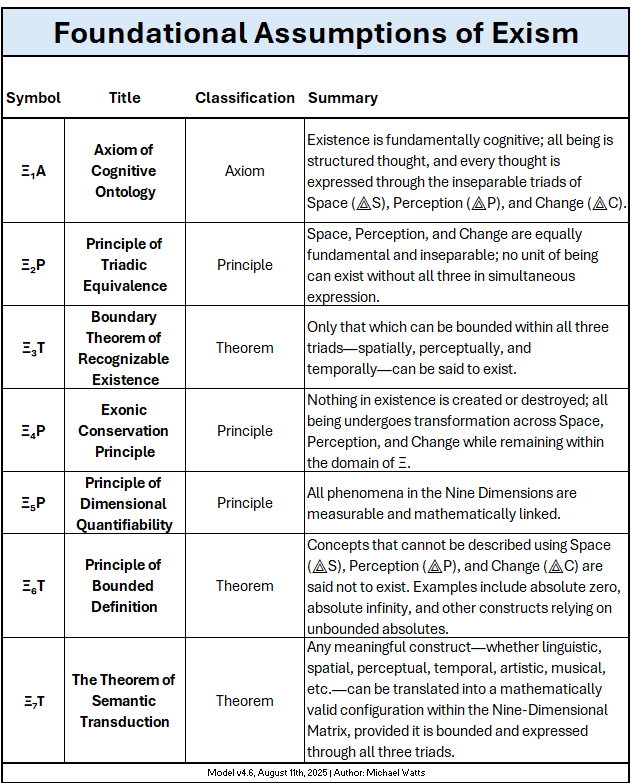
Table: Foundational Assumptions of Exism and Their Symbolic Shorthand
Symbol
Title
Classification
Summary
Ξ₁A
Axiom of Cognitive Ontology
Axiom
Existence is fundamentally cognitive; all being is structured thought.
Ξ₂P
Principle of Triadic Equivalence
Principle
Space, Perception, and Change are equally fundamental to any unit of being.
Ξ₃T
Boundary Theorem of Recognizable Existence
Theorem
Only that which can be bounded and perceived can be said to exist.
Ξ₄P
Exonic Conservation Principle
Principle
Nothing is created or destroyed; all existence is transformation.
Ξ₅P
Principle of Dimensional Quantifiability
Principle
All phenomena in the Nine Dimensions are measurable and mathematically linked.
Ξ₆T
Principle of Bounded Definition
Theorem
Zero and infinity are unrecognizable and therefore outside existence.
Ξ₇T
Theorem of Semantic Transduction
Theorem
Any bounded construct can be translated into mathematical form within the Nine-Dimensional Matrix.
Closing Thoughts
These seven assumptions are not abstractions to be admired from a distance—they are the load-bearing walls of Exism’s architecture. To apply them, we need a framework that can hold every bounded form, every act of perception, and every transformation in coherent relation. That framework is the Nine-Dimensional Matrix of Existence: a coordinate system that translates the principles of Exism into measurable structure. In the next chapter, we begin with its Cartesian form, defining the three triads in the physical terms of location, scale, and structural relation before extending into the relational polar systems that follow.
Chapter 2: The Nine-Dimensional Matrix of Existence
Measuring Consciousness through Cartesian Structure
"Everything must be made as simple as possible—but not simpler."
— Albert Einstein
Introduction
What if everything you experience—matter, thought, perception, choice, and change—could be described by nine interrelated dimensions? Not merely the familiar directions of space or the linear flow of time, but a deeper, unified system that includes the internal geometry of consciousness.
This chapter introduces the Nine-Dimensional Matrix of Existence (Ξ): a complete ontological model that defines how consciousness is bounded and how it becomes measurable.
The Matrix consists of three Cartesian triads:
-
Space (⟁S) – the structural framework of form
-
Perception (⟁P) – the internal assignment of meaning
-
Change (⟁C) – the dynamic field of transformation
Each triad contains three structural dimensions, yielding a total of nine coordinate axes. These axes together define the volumetric structure of Consciousness—the measurable domain through which an observer experiences, interprets, and transforms reality.
In Exism, each triad can be expressed in two coordinate systems: Cartesian (structural) and Polar (relational, discussed in the following chapter).
This chapter focuses solely on the Cartesian formulation, which provides the foundational volume for bounded Consciousness.
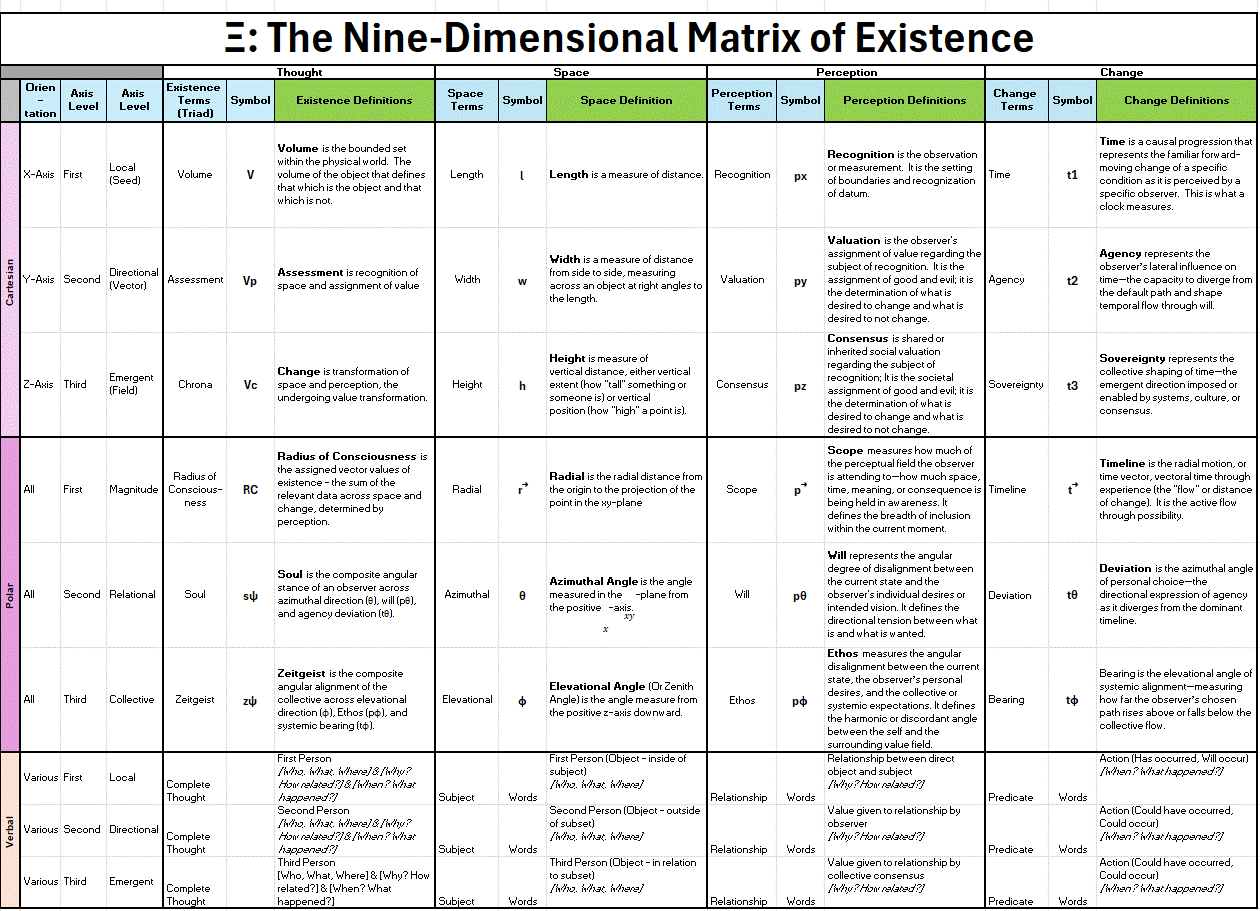
Triad
Cartesian Dimensions
Space (⟁S)
Length (l), Width (w), Height (h)
Perception (⟁P)
Recognition (px), Valuation (py), Consensus (pz)
Change (⟁C)
Time (t₁), Agency (t₂), Sovereign Shift (t₃)
The Cartesian Triad of Space - The Structural Dimensions of Form
The Triad of Space defines the structural environment within which existence is bounded and located. It is the most intuitive of the triads, grounded in physical measurement and objective distinction.
This triad provides the containment, scale, and volumetric context in which Consciousness can emerge. Space is not abstract—it is the literal framework of being.
Dimension
Description
Length (l):
Linear extension along a primary axis
Width (w):
Perpendicular span across a surface
Height (h):
Vertical extent or elevation
These dimensions define the familiar Spatial-based Volume:
V = l × w × h
Within Exism, this becomes the spatial component of the Matrix:
-
Boundedness – the containment of form
-
Physical distinction – separability of entities
-
Occupational capacity – space for presence and relation
Cartesian Space does not define what a thing means.
It defines where it is, how large it is, and how it relates physically to other entities.
This triad forms the first pillar in the construction of Consciousness—essential for modeling boundary, location, and relation in physical form.
The Cartesian Triad of Perception - The Structural Dimensions of Meaning
Whereas Space defines the frame, Perception defines the contents of awareness—the internal structure of observation, evaluation, and shared understanding.
The Cartesian Triad of Perception governs the interpretive process by which spatial elements gain cognitive and emotional significance. It distinguishes a movement from a motive, a shape from a symbol.
Dimension
Description
Recognition (px):
Identification of a bounded element—what is noticed
Valuation (py):
Assignment of internal emotional or personal meaning
Consensus (pz):
Degree of alignment or reinforcement by other observers
These form the Perceptual Volume of Assessment:
Vp = px × py × pz
This volume is not directional, but bounded—it represents the evaluative content actively held in the field of awareness. Perception provides:
-
Cognitive focus (px)
-
Subjective weight (py)
-
Social reflection (pz)
It is the triad that makes raw data meaningful—enabling an observer not only to see, but to care, judge, and share.
The Cartesian Triad of Change - The Structural Dimensions of Transformation
The Triad of Change introduces temporal geometry—the dimensional structure of how states evolve. Unlike flat models of time, Exism’s Change triad is three-dimensional, representing not only sequence but also choice and collective transformation.
Dimension
Description
Time (t₁):
The linear, causal flow of moments (timeline vector)
Agency (t₂):
The observer’s capacity to diverge (choice vector)
Sovereignty(t₃):
Transformation via collective influence or systemic inertia
These axes form the Temporal Volume of “Chrona”:
Vc = t₁ × t₂ × t₃
This volume defines the field of transformation available to the observer:
-
t₁: What flows by default (momentum)
-
t₂: The observer’s ability to diverge (agency)
-
t₃: Collective evolution and systemic momentum (sovereignty)
Change is not passive. It is a bounded, measurable force—just as real as space, but entirely about transformation and potential.
The Volume of Consciousness
When the three Cartesian triads are combined, they define the full volumetric structure of bounded experience:
V⟁ = Vₛ × Vp × Vc = (l × w × h) × (px × py × pz) × (t₁ × t₂ × t₃)
This is the Cartesian volume of Consciousness:
A being’s location, meaning, and becoming—expressed as a measurable structural domain.
Exism treats Consciousness not as mystery, but as math—a volume of thought, form, and transformation.
Why This Cartesian Model of Existence Matters
Most philosophical systems separate thought from structure, or function from form.
Exism does not.
It asserts that to exist in a measurable sense is to:
-
Occupy Space (⟁S)
-
Evaluate through Perception (⟁P)
-
Transform through Change (⟁C)
All entities that exist across all three triads—whether biological, artificial, or theoretical—manifests Observerhood, though their consciousness magnitudes can differ. The greater the alignment across both Cartesian and Polar dimensions, the more expansive the Consciousness.
To assist with quick reference and easier visualization of these concepts found throughout the book, you can find helpful guides in the appendix. Appendix A contains an easy to visualize matrix of the nine-dimensions. Appendix B is a lexicon of various definitions and formulas discussed in this book. Appendix C is the list of the foundational assumptions of Exism.
Closing Thoughts
Of course, there is more than one way to understand orientation than through Cartesian measures alone. To navigate that terrain, Exism turns to Polar geometry. Here, the same triads of Space, Perception, and Change are expressed not through fixed linear measurements, but as radii and angles—measures of stance, bearing, and trajectory. If Cartesian coordinates describe the frame, Polar coordinates reveal the aim.
Chapter 3: Existence and Polar Geometry
Measuring the Alignment of Consciousness
“Emotion is not chaos—it is alignment rendered visible.”
— Exism
Introduction
In Chapter 2, we described consciousness using the Cartesian structure—a framework of linear axes representing form (⟁S), meaning (⟁P), and transformation (⟁C). That model defined the volume of consciousness: bounded, measurable, and structural.
But not all facets of being are static or structural. Many are relational—they depend on direction, alignment, divergence, or resonance. Cartesian coordinates can define what and how much, but not where it is aimed, how far off-course, or what direction the observer is truly facing.
To capture these directional qualities, we must shift from Cartesian to Polar coordinates. The Polar model of Existence still operates within the same triads—Space, Perception, and Change—but describes them in terms of radius (r), azimuthal angle (θ), and elevation angle (φ). These define not just position, but stance, orientation, and trajectory.
Triad
Radius
Azimuthal Angle
Elevational Angle
All
r – Radian distance
θ – Horizontal direction
φ – Vertical orientation
Perception
pr – Scope
pθ – Will
pφ – Ethos
Change
tr – Timeline
tθ – Deviation
tφ – Bearing
This chapter introduces:
-
The Polar Triads of Space, Perception, and Change
-
The Radius of Consciousness as the base scalar for polar modeling
-
The Soul (sψ) and Zeitgeist (zψ) as directional composites
-
The Spirit (V⚯) as the resonance between the two
-
Why polar modeling is essential for navigating identity, ethics, and transformation.
Polar Space — Orientation of Form
Even physical form behaves directionally, not just positionally. In dynamic systems, spatial orientation matters more than absolute location. This is where Polar Space becomes essential.
Concept
Symbol
Description
Radial
r⃗
Scalar distance from the observer’s origin
Azimuthal Angle
θ
Rotation in the xy-plane
Elevation Angle
φ
Vertical direction from z-axis downward
Polar Space is used to model:
-
Fields of motion (sound, light, force)
-
Orbital paths or spirals
-
Orientation between moving observers
Whereas Cartesian space tells us where, polar space tells us how far, and in what direction.
This distinction is critical in Exism, as our interests often lie less with position, and more with where it is facing, what it is pursuing, and what it is resisting.
Polar Perception — Orientation of Meaning
Perception is not passive. It is a directional, evaluative act—one that aims, filters, and responds.
Concept
Symbol
Description
Scope
pr
The breadth of attention and awareness in the moment
Will
pθ
The azimuthal angle of personal desire or vision
Ethos
pφ
The elevational angle of social/systemic influence
These are the angular components of perception that define where we are mentally aimed—not just what we see, but what we want and resist.
Polar Change — Orientation of Transformation
Change is not linear. It flows through time, but also deviates from expectations, and responds to systems of influence.
Concept
Symbol
Description
Timeline
tr
Radial span of experienced possibility
Deviation
tθ
Azimuthal angle of personal agency (divergence from norm)
Bearing
tφ
Elevational angle of systemic trajectory (dominant direction)
These allow us to describe not just how long something takes—but where change is headed, who is shaping it, and how likely a path is to unfold.
Radius of Consciousness
To unify directionality and magnitude, we define the Radius of Consciousness (RC):
Concept
Symbol
Formula
Radius of Consciousness
RC
√(V² + Vp² + Vc²)
Where:
-
V = Volume (Space)
-
Vp = Assessment (Perception)
-
Vc = Chrona (Change)
RC is the base scalar for interpreting all polar constructs in Exism. It represents the observer’s total conscious magnitude across form, meaning, and transformation.
Soul — Directional Orientation of the Observer
The Soul in Exism is not a container of spirit or energy—it is a directional composite, an angular representation of an observer’s perceptual stance across three axes:
Soul = (θ, pθ, tθ)
Symbol: sψ
Note: ψ represents composite angular magnitude across multiple directional polar components
It is computed as:
This scalar angle (in radians) represents the net directional orientation of the observer relative to their internal will and divergence.
Interpretive Examples:
-
Low sψ → High alignment and clarity
-
High sψ → Disorientation, contradiction, or perceptual tension
Note to the Reader:
The use of the term Soul may be controversial to some, as it carries varied philosophical, religious, and cultural connotations. Within Exism, it is simply the most suitable term available in English to approximate the intended concept. As always, Exism remains open to refinement. Should a more precise term emerge in future volumes, it will be considered. But the concept is what matters most—the name is only a label for expedient language-based communication.
Zeitgeist — Directional Orientation of the Collective
The Zeitgeist is the collective counterpart to the Soul: a directional composite of how the era, culture, or system is oriented.
Zeitgeist = (φ, pφ, tφ)
Symbol: zψ
It is computed as:
This scalar measures how unified or dissonant the collective experience is across spatial elevation, perceptual inheritance, and systemic influence.
Interpretive Examples:
-
Low zψ → Clear social trends, systemic flow
-
High zψ → Fragmentation, historical upheaval, cultural confusion
Spirit — Resonance Across Dimensions
Spirit is not a thing. It is the resonance between the Soul and Zeitgeist—between personal perception and systemic momentum.
This models:
-
How powerful collective influence is (zψ)
-
How far off-course the observer is (sψ)
-
How aware the observer is (RC)
Interpretive Matrix:
Conflict
Axis Pair
Interpretation
Will Integrity
pθ vs tθ
Vision vs Action
Social Harmony
pφ vs tφ
Desire vs System
Internal Tension
pθ vs pφ
Ideal vs Consensus
Awareness Match
pr vs tr
Scope vs Possibility
Why the Polar Model of Existence Matters
Both Cartesian and Polar coordinate systems are valid nine-dimensional models in Exism, each describing the triads of Space, Perception, and Change. However, they serve distinct purposes and possess different strengths.
-
Cartesian modeling excels at determining whether a phenomenon exists within the structural bounds of a triad. It is essential for constructing precise mathematical equations and for measuring magnitude, position, and boundedness.
-
Polar modeling, by contrast, is optimized for relationships and alignment. It is particularly effective at representing directionality, resonance, and the interplay between intent and context.
Where Cartesian models quantify what is, polar models reveal where it is going, in relation to others,—and why.
Polar modeling enables us to:
-
Analyze moral conflict as geometric dissonance.
-
Track cultural revolutions as shifts in collective orientation.
-
Predict tipping points of transformation as misalignment builds.
-
Visualize the resonance or friction between individual and system.
It offers a natural language for emotional mathematics—where Scope, Will, and Ethos form a vector of perception, and Deviation, Timeline, and Bearing define the movement of change.
More importantly, it helps us understand ethical dynamics. Are we trying to change the individual to fit society, or transform society to align with the individual?
To live wisely in an evolving world is to:
-
Maintain clarity of stance.
-
Discover misalignment early.
-
Take action to realign with your goals.
This is not just modeling, this is navigation—of being, will, and transformation.
Closing Thoughts
Polar modeling completes what Cartesian modeling begins. Cartesian coordinates define structure—the measurable boundaries of form, value, and transformation. But without orientation, structure alone is inert. Polar coordinates define stance—the directional force behind perception, choice, and alignment. They allow us to see not just where something is, but where it is aimed, how it diverges, and with what it is resonating.
In a world where direction often matters more than position, and where meaning is a matter of alignment, polar modeling becomes essential. To exist is not merely to be, become, and be witnessed—it is also to feel, resist, realign, and transform—with or against the desires of others.
In both Cartesian and Polar modeling, the triads only remain coherent when their measures are finite and non-zero. Orientation without bounds dissolves into directionless drift; structure without limits collapses into undifferentiated mass. If alignment is the heart of navigation, then absolutes are its dead ends. And yet, zero and infinity—0 and ∞—have long fascinated mathematicians, mystics, physicists, and philosophers. They represent the imagined boundaries of experience: the extremes of absence and totality. But within Exism, these concepts reveal a fatal flaw: they are unbounded, and thus unrecognizable, unrelational, and incoherent.
Chapter 4: The Illusion of 0 and ∞
Why Nothing and Everything Can’t Mean Anything
"Absolutes are the enemies of understanding.”
— Exism
Introduction
In both Cartesian and Polar modeling, the triads only remain coherent when their measures are finite and non-zero. Orientation without bounds dissolves into directionless drift; structure without limits collapses into undifferentiated mass. If alignment is the heart of navigation, then absolutes are its dead ends.
And yet, zero and infinity—0 and ∞—have long fascinated mathematicians, mystics, physicists, and philosophers. They represent the imagined boundaries of experience: the extremes of absence and totality. But within Exism, these concepts reveal a fatal flaw: they are unbounded, and thus unrecognizable, unrelational, and ultimately incoherent.
If we are to build a philosophy of existence grounded in:
-
Ξ₁A – Axiom of Cognitive Ontology
-
Ξ₂P – Principle of Triadic Equivalence
-
Ξ₃T – Boundary Theorem of Recognizable Existence
…then we must reject any system that claims existential meaning from 0 or ∞ as real states. They are symbolic placeholders, not viable coordinates within the Nine-Dimensional Matrix of Existence.
The Fallacy of Zero
Zero is often described as:
-
The origin point
-
The absence of quantity
-
The null condition
-
A symbolic void
But Exism rejects the existence of true zero as an ontological condition.
Why?
Dimension
Failure Mode
Scope (pr)
A field with no awareness cannot exist as a bounded soul.
Timeline (cr)
No radial time span can be defined from a null state.
Deviation (cθ)
Without divergence, there is no agency, no intent, no action.
This directly violates:
-
Ξ₁A – Existence is Thought
-
Ξ₃T – Only that which can be perceived and bounded exists
Even the most minimal state of consciousness must include some perceptual span (pr), some timeline motion (cr), and some directional stance (pθ or cθ). True zero negates all three and thus violates the minimum threshold for Consciousness (V⟁) or Soul (sψ) to form.
Example: Philosophical "Nothingness"
In Taoist or existential frameworks, “nothingness” is sometimes treated as a fertile void. But the moment it gives rise to any perceivable event, it ceases to be nothing. The system collapses—by creating, it becomes non-zero.
The Fallacy of Infinity
Infinity is often imagined as:
-
Omnipotence
-
Omniscience
-
Eternal duration
-
Total unity
But Exism denies true infinity as a coherent coordinate or experience.
Why?
Dimension
Failure Mode
Scope (pr)
Infinite perceptual inclusion leads to perceptual collapse—no boundary, no relevance.
Bearing (cφ)
Without elevation relative to others, no dominant vector or Zeitgeist can emerge.
Ethos (pφ)
Perfect alignment with all possibilities cancels directional meaning; pφ → 1 collapses Ethos vector into nondirectionality.
This violates:
-
Ξ₂P – Triadic Equivalence: Each axis must be bounded
-
Ξ₅P – Dimensional Quantifiability: All values must be measurable within a finite structure
Example: “Omniscience”
Omniscience is often described as perfect knowledge—complete recognition of all things, across all time, without error, doubt, or limitation. But within Exism, this construct collapses when mapped into the Cartesian model of Perception.
To claim omniscience, one must assume infinite recognition (px), infinite valuation (py), and total consensus (pz).
-
Infinite recognition erases all frames of reference—perception loses focus.
-
Infinite valuation leads to contradiction or flatness—preferences dissolve.
-
Perfect consensus removes the basis for meaning—no contrast remains.
Therefore, "omniscience" is not a condition of enhanced perception—it is the collapse of perceptual mechanics. In trying to know all, it knows nothing in particular. Both conditions—zero and infinity—fail not in isolation, but in their common inability to sustain structure or distinction. The result is the inescapable collapse of coherence.
Concept
Collapse Mode
Violates
Zero (0)
Lacks bounded awareness, directional agency, and change
Ξ₁A, Ξ₃T
Infinity (∞)
Destroys perceptual focus and temporal orientation
Ξ₂P, Ξ₅P
Meaning
Fails to emerge under 0 (no structure) or ∞ (no distinction)
All the above
The conclusion is that zero and infinity are not existential coordinates; they are symbolic extremes that fail every structural requirement of Exism
Counterexamples and Why They Fail
Despite these flaws, many systems still attempt to apply 0 and ∞ as meaningful constructs. Let us examine why these claims falter under Exism.
Claim
Why It Fails in Exism
"The universe is infinite."
We can only perceive a bounded scope (pr). Violates Ξ₃T.
"Before the Big Bang, there was nothing."
The word “nothing” is a placeholder for unknown states—not zero.
"God is infinite and perfect."
Must be redefined using Ξ₇T (Semantic Transduction) as metaphor.
"Absolute zero is real."
Unreachable in physics—validates Exism’s asymptotic model.
"The multiverse is infinite."
Vast ≠ unbounded. Emergence is not totality. Violates Ξ₄P, Ξ₅P.
Many foundational claims across philosophy, science, and theology that invoke zero or infinity begin to collapse under Exism. These concepts, when examined through the Nine-Dimensional Matrix, either rely on unreachable abstractions, violate the principles of bounded perception, or confuse symbolic metaphor with existential reality. Exism does not reject these systems wholesale—it reframes their claims as misapplied language or failed mappings, revealing their incoherence when held to the standards of recognition, distinction, and measurable change.
To prevent such collapses, Exism formalizes a safeguard—a theorem that defines the outer limits of valid meaning itself. This is Ξ₆T, the Principle of Bounded Definition.
Ξ₆T – The Principle of Bounded Definition
Ξ₆T – Theorem: The Principle of Bounded Definition
Any term or system that relies on true zero or true infinity is undefined, unrelational, and ultimately incoherent within the Nine-Dimensional Matrix.
So, why does this theorem matter? To exist is to be perceivable, bounded, and distinct. Exism defines recognition as the minimal condition for perception, and perception as the foundation for existence (per Ξ₁A and Ξ₃T). Therefore, any concept that collapses boundaries—by negating all dimensions (0) or dissolving all distinction (∞)—cannot be recognized and thus cannot exist.
Triad
Dimension
Collapse Mode (0 or ∞)
Result
Perception
Scope (pr)
0 = No field to perceive
∞ = No boundary to separate values
Nothing is recognized
Will (pθ)
0 = No valuation
∞ = All values equivalent
No distinction or preference
Ethos (pφ)
0 = No resonance
∞ = Total resonance
Loss of directionality and feedback
Change
Timeline (cr)
0 = No flow
∞ = No temporal frame
No sense of before or after
Agency (cθ)
0 = No deviation
∞ = Total divergence
No coherent actionable agency
Sovereign (cφ)
0 = No shared arc
∞ = All arcs equal
No meaningful collective agency
Space
Volume (V)
0 = No body or form
∞ = All form
Spatial indistinction
Every axis in the Nine-Dimensional Matrix is defined by its boundedness. Without limits, dimensions cease to relate, and without relation, no term can be meaningfully defined.
✅ Summary of Ξ₆T
-
Zero negates the preconditions for recognition.
-
Infinity destroys the ability to distinguish.
-
Ξ₆T asserts that all valid concepts must:
-
Be relational (interact with other dimensions)
-
Be bounded (have measurable extents)
-
Be coherent (avoid internal contradiction across triads)
-
Asymptotic Boundaries in Exism
Exism does not discard the symbols 0 or ∞ entirely. Instead, it reframes them as asymptotic boundaries—extreme directions that perception and experience may approach but can never attain.
-
Zero (0) is asymptotically approached through states of increasing simplicity, detachment, or entropy—but can never be fully realized. A coordinate with no recognition (px = 0), no valuation (py = 0), or no time (t₁ = 0) represents a non-state—a collapse of all meaningful structure.
-
Infinity (∞) is likewise approached through scaling, resonance, or maximal expansion—but it collapses structure when reached. Infinite valuation (py → ∞), for example, erases all contrast between good and bad. Infinite consensus (pz → ∞) removes all dissonance, making agreement meaningless. Infinite agency (t₂ → ∞) implies boundless divergence, which nullifies shared timelines.
Within Exism, all observer states must remain bounded. These dimensions must always hold finite, non-zero values to be coherent. If any axis collapses to 0 or expands to ∞, the observer’s perceptual or transformational coherence collapses with it.
Thus, Exism defines all meaning as existing within asymptotic constraints—approaching but never becoming zero or infinity. Truth, choice, and perception require limits, and those limits define the shape of experience. This allows for the use of 0 or ∞ for mathematics, not as absolutes but as asymptotic concepts.”
Domain
Use of 0 or ∞
Exism’s Interpretation
Mathematics
Identity (0), Limits (∞)
Formal abstractions, not ontological claims
Physics
Singularity, vacuum, entropy
Model failure points, not real-world states
Theology
Eternity, omnipresence
Metaphors of idealization, not coordinate vectors
Information Theory
Min/max entropy
Bounded approximations—never actualized states
Exism fully supports the use of 0 and ∞ as symbolic tools—but denies their truth status as measurable, existential conditions.
Having reframed these symbols as directional asymptotes rather than destinations, we now return to the heart of Exism’s claim that existence only holds meaning when bounded.
Closing Thoughts
Where nothing is, nothing can be known. Where everything is, nothing can be distinguished. Zero and infinity destroy structure. They eliminate contrast, erase transformation, and collapse the coordinate systems that make being, perceiving and action possible. Existence is only meaningful within limits.
If existence only holds meaning within bounds, then morality cannot stand outside those same constraints. The asymptotic nature of zero and infinity shows that absolutes—whether in mathematics, physics, or theology—collapse structure when reached. So too with “good” and “evil”: if they were infinite, they would erase contrast and nullify choice; if they were zero, they would vanish as categories. In Exism, morality is not an unchanging decree, but a set of coordinates—bounded, relational, and measurable across the triads. With the tools now established, we can map moral judgment not as dogma, but as an emergent geometry of human and collective choice.

Chapter 5: Good and Evil
Why Relativity Is So Critical
“The line separating good and evil passes not through states, nor between classes, nor between political parties — but right through every human heart.”
— Aleksandr Solzhenitsyn
Introduction
Having stripped away the mirage of absolutes, we find ourselves in a strange freedom. If neither zero nor infinity exists in the way we once believed, then so too must we question the absolutes of morality. Are “good” and “evil” fixed truths, or are they coordinates—measured, situated, and relative to the observer? With the tools of Exism now in hand, we can map morality not as dogma, but as an emergent geometry of human and collective choice.
"Good" through the Lens of Exism
In Exism, existence is structure—defined, bounded, and made measurable across the nine-dimensional matrix. So, to understand “good,” we do not ask what it is in some objective moral sense—we ask:
“What does it look like when a thing is perceived as good, given the triads of Space, Change, and Perception?”
Let us build the idea piece by piece.
1. Ξ₂P – Triadic Equivalence
No analysis of “good” is meaningful unless it is grounded in space (action/event), change (effect/trajectory), and perception (valuation/meaning). So “good” is not an isolated property—it emerges from alignment across the triads.
Let us map that:
Triad
Dimension
Possible Role in “Good”
Space
Physical reality
Something happened or was done (a material act)
Change
Trajectory, agency, shared direction
That act led to beneficial change, or aligned with desired trajectory (⚯⃗)
Perception
Personal/collective valuation
That change is seen as desirable by the observer and/or others (pθ and pφ)
2. Perception as the Crucial Triad
Because good and evil are value-based judgments, the Perception triad becomes the primary interpreter. But perception is not static—it is directional and measured via:
-
Scope (pr): How broad is the soul witnessing this event?
-
Will (pθ): Does the event align with the observer’s will?
-
Ethos (pφ): Does the event align with the collective's directional desire?
So “good” emerges when: An event or change (in space-time) resonates positively across both pθ and pφ, with a sufficiently large Scope (pr) to meaningfully integrate consequence.
You can feel something is good when you want it (pθ ≈ 0°) and others do too (pφ ≈ 0°), and your soul has the scope to perceive the change across domains.
3. Change Triad Confirmation
Good is not just a perceptual alignment—it must also hold up within the Change triad, which models transformation across time through individual deviation and systemic flow. A good act must engage with these temporal dimensions in a coherent and constructive way:
Dimension
Symbol
Role in Good
Time
t₁
The act must unfold across a meaningful temporal progression—it is not a flash of reaction, but a sustained transformation within time.
Agency
t₂
The act must reflect the observer’s capacity to intentionally diverge from the default path—Agency is the power to shape time, not pass through it.
Sovereignty
t₃
The act must contribute to the collective’s shaping of time—either by aligning with or constructively redirecting the dominant systemic trajectory.
While Agency (t₂) grants the observer the freedom to act independently, Sovereignty (t₃) represents the systemic vector of change—what institutions, cultures, and consensus are already moving toward. When the observer's actions diverge too radically from this collective direction, especially without sufficient Scope (p⃗), those actions may appear “good” from a personal Will (pθ) but will lack coherence within the larger system.
A purely selfish act (low Ethos alignment or high pθ-pφ dissonance) may feel good to the individual, but if it also exhibits a large misalignment in Bearing (tφ)—meaning it undermines or falls below the systemic trajectory of Sovereignty (t₃)—it is unlikely to be stable Good. As perceptual Scope (p⃗) increases, the destructive impact becomes more visible, and the act may collapse into ethical incoherence.
4. Exonic View of Good
According to Ξ₄P – The Exonic Conservation Principle, nothing is created or destroyed—only transformed.
So good might be rephrased as a transformation that preserves or enhances alignment across the Nine Dimensions for one or more observers. This alignment is always conditional on the observer’s state.
5. No Absolute Good (Ξ₃T)
Per Ξ₃T – Only what is bounded and perceived exists – “good” must be bounded within perception. Therefore:
-
No act is universally good.
-
But some acts are widely experienced as good across varied observers with overlapping angular alignments.
Summary Definition:
Good is a transformation within space-time that increases alignment between the observer’s Will (pθ) and the collective Ethos (pφ), within a sufficiently broad perceptual Scope (p⃗), and across a change arc where Agency (cθ) supports or redirects the dominant Sovereign path (cφ).
It reflects a directional state in which the individual’s desired outcome harmonizes with, or ethically challenges, the collective trajectory—while remaining measurable, bounded, and observer-relative across the Nine-Dimensional Matrix of Existence (Ξ).
Evil is a transformation within space-time that increases disalignment between the observer’s Will (pθ) and the collective Ethos (pφ), occurring within a narrow or constrained perceptual Scope (p⃗), and across a change arc where Agency (cθ) actively opposes, distorts, or degrades the dominant Sovereign path (cφ).
Dilemma Example: Stealing Medication to Save a Life
Let us proceed with a real-world dilemma that is morally complex, widely discussed, and suitable for Exism’s multi-dimensional analysis.
Scenario:
A woman’s child is dying from a rare condition. The only available medication is patented and costs $20,000. She cannot afford it, and the company refuses to lower the price. Desperate, she breaks into a pharmacy warehouse and steals a dose to save her child.
Across various ethical systems, we get nuanced reactions:
-
Utilitarianism: The net happiness is greater with the child saved—stealing is justified.
-
Deontology (Kant): Stealing is categorically wrong, regardless of outcome.
-
Virtue Ethics: The mother displays courage and compassion, which are virtues.
-
Legalism: She broke the law and must face consequences—even if the motive was noble.
-
Common Intuition: Most people sympathize with the mother; her action feels “good,” even if technically illegal or morally ambiguous.
Now let us evaluate the action across Space, Change, and Perception:
1. Space Triad: The Physical Act
-
Object: A vial of life-saving medication.
-
Action: Theft of that vial.
-
Context: Desperation, no other avenues available.
-
Effect: Child survives.
So, the act in space is bounded and knowable: it is theft, but with a directly beneficial material outcome (saving a life).
2. Change Triad: Transformational Arc
Dimension
Value in Scenario
Timeline (cr)
The long-term consequence is a continued life and the possibility of new moral or legal norms being challenged.
Agency (cθ)
The mother exhibits high agency—conscious intent and willful deviation from passive compliance.
Sovereign (cφ)
The sovereign misalignment is the issue: collective law currently criminalizes her action. But emergent consensus may begin to shift in her favor if the injustice is widely perceived (the sovereign is not fixed—it can evolve).
Interpretation: The trajectory shows short-term misalignment with law, but potential long-term alignment with emerging moral values.
3. Perception Triad: Value Alignment
Dimension
Value in Scenario
Scope (pr)
High, if the observer has sufficient Will to see systemic injustice; low if focused narrowly on legality.
Will (pθ)
From her view: strong alignment—"I value my child’s life over corporate control."
Ethos (pφ)
Somewhat aligned—many in society sympathize with her values (empathy, justice), but corporate and legal systems currently do not.
Interpretation: The act is ethically good from her Will, and partially good from collective perception, especially as awareness spreads.
❖ Overall Exism Evaluation:
This act constitutes a high-agency, high-perception, transformative deviation from established norms, which—if seen across a broad enough perceptual scope—represents a morally “good” vector despite current legal or systemic misalignment.
It is:
-
Good in pθ and pr (her will and the size of her determination)
-
Partially good in pφ (some consensus)
-
Transformational in cr
-
Agentic in cθ
-
Challenging but possibly redirective in cφ
Considering Polar Orientation
Polar Term
Symbol
Application to Scenario
Value/Interpretation
Scope
pr
How much of the situation the mother (or observer) is considering
High pr: The mother considers life, death, law, injustice, systemic cruelty—not just the act of theft. A narrow observer (low pr) might see only “a crime.”
Will
pθ
Observer’s will vs the current reality
Low pθ: For the mother, her will is closely aligned with the desired outcome—saving her child. The smaller this angle, the more righteous it feels to her.
Ethos
pφ
Collective stance vs observer’s will
Moderate-to-high pφ: There’s social empathy from the public (partial alignment), but law and policy diverge—this creates tension. The collective is not fully in resonance.
Timeline
cr
How much the change impacts future conditions
High cr: The act redirects the child’s life trajectory. It could also contribute to social or legal reform (if publicized).
Agency
cθ
The angle between the current flow of reality and the agent’s assertive divergence
Very low cθ: The mother exerts intense will—conscious, focused divergence from the system. She does not drift into this act. She chooses it.
Sovereign
cφ
Elevation of collective agency vs the act
High cφ at present—society (via law) opposes the action. However, Sovereign trajectory may bend if enough individual observers shift consensus. That change is directional, not instantaneous.
Visualization Summary
The mother’s Scope (pr) is wide—she sees the long-term, emotional, legal, and existential stakes. Her Will angle (pθ) is small—her action tightly aligns with her inner will. But her Ethos angle (pφ) is conflicted: society partially sympathizes with but still criminalizes the act.
In the triad of Change, she exerts focused Agency (cθ ≈ 0°), creating a strong deviation from passive acceptance. Her Timeline (cr) is meaningful—life is saved, and ethical discourse is sparked. Yet Sovereignty alignment (cφ) remains discordant—collective power structures resist.
Why This Helps Explain “Good”
Instead of simply saying “this is a morally gray area,” the polar definitions let us measure the forces acting on and within the observer and the system:
-
pr, pθ, pφ describe the perceptual orientation of both the actor and any observer trying to judge.
-
cr, cθ, cφ describe the temporal arc and system-wide impact of the act itself.
These are not abstract symbols—they model real moral geometry.
Example: Observer A (Law-Enforcement Perspective)
-
pr: Low (just sees theft)
-
pθ: High (doesn’t want the law violated)
-
pφ: High (believes in institutional order)
-
Judgment: Bad act. Arrest.
Example: Observer B (Ethically Aware Bystander)
-
pr: High (sees context and history)
-
pθ: Low (wants justice for the child)
-
pφ: Moderate (understands laws, but feels torn)
-
Judgment: Good act, perhaps necessary evil
Angular Misalignment = Ethical Tension
The larger the gap between pθ and pφ (or between cθ and cφ), the more ethically stressful a situation becomes. The mother’s act causes angular dissonance, not because it lacks value, but because it challenges the current dominant vector of the Sovereign (cφ) while being tightly aligned with her own vision (pθ).
This gives us a framework to calculate when something feels controversial but is actually part of an emergent moral realignment.
Critique: Comparing Current Dominant Moral System and Exism
Standard Moral Systems
Exism View
Focus on act or consequence
Focus on multidimensional trajectory
Fixed rule (e.g., never steal)
Dynamic context: What does this action do across space, change, and perception?
Morality can be binary
Morality is vector-based, not binary. Good is a matter of directional alignment
Individual vs society
Evaluated across both personal and collective orientation
Sympathy is subjective
Sympathy is quantifiable via pr, pθ, pφ
Exism’s strength is in showing why the act feels morally good to many people, even though it is legally bad. It also shows how to measure the moral force of the act, and when such an act might shift collective consensus.
Exism Formula for "Goodness Value" (G)
Symbol
Meaning
p⃗
Scope: The radial breadth of the observer’s perceptual field (normalized 0 to 1)
pθ - pφ
Angular difference between Will and Ethos: smaller angle = more alignment
cθ - cφ
Angular difference between Agency and Sovereignty: smaller angle = more alignment
cos(x)
Used to quantify angular alignment: cos(0°) = 1 (perfect alignment), cos(180°) = -1 (total opposition)
Define Variable Values (from her perspective)
Variable
Meaning
Assigned Value
Rationale
p⃗
Scope
0.9
She is aware of: the child’s life, corporate greed, lawbreaking, moral complexity, systemic injustice—high perceptual breadth.
pθ
Will
0°
Her Will is fully aligned with saving her child. This is her direct vision.
pφ
Ethos
20°
While many sympathize, societal norms and laws still disapprove of theft—moderate alignment.
cθ
Agency
10°
She deliberately diverges from the lawful default path—strong but slightly offset action.
cφ
Sovereignty
40°
Current Sovereign path (law, pharmaceutical enforcement) is not aligned with her deviation—some dissonance, but not total opposition.
Step 2: Plug into Formula
Interpretation:
The result was Good ≈ 0.73, which we interpret as a high goodness value.
-
The action is strongly ethical from a multidimensional view.
-
Her high Scope (p⃗ = 0.9) amplifies the value.
-
Her Will (pθ) is close to societal Ethos (pφ)—showing moral justification even if law is violated.
-
Her Agency (cθ) diverges, but not radically.
-
The Sovereign path (cφ) is misaligned, but not destructively so—she’s pushing against policy, not destabilizing civilization.
Optional Extensions:
-
From a corporate observer's view:
-
pθ = 60°, pφ = 0°, cθ = 75°, cφ = 10°
→ Likely Good ≈ 0.1 to 0.2 (low).
-
-
From a systemic reformer's view:
-
pθ = 10°, pφ = 10°, cθ = 20°, cφ = 15°, p⃗ = 0.95
→ Good ≈ 0.88 (very high)
-
Conclusion:
The Goodness formula gives a numeric and interpretable measure of ethical transformation. In this case:
-
Good ≈ 0.73 = A morally powerful act
-
Especially when viewed with high Scope and sympathetic Ethos alignment
-
The disalignment with law (cφ) reduces the score slightly, but does not override its ethical coherence
Closing Thoughts
Under Exism, “good” is not a condition—it’s a convergence of vectors: spatial actions, temporal arcs, and perceptual alignment. In this case, the mother’s act is not universally good, but it carries a high moral trajectory—a directional movement toward collective realignment.
Understanding the geometry of “good” is essential, but it is only one vector in the ethical field. Every act also carries its own dissonances—points of misalignment that pull against its moral trajectory. To navigate morality fully, we must place both forces—good and evil—into the same dimensional frame, measuring their relative magnitudes and directions. Only then can we see the net moral value of an action: whether it advances, impedes, or distorts the shared field of awareness.
Chapter 6: The Measure of Moral Value
Mapping Ethics in a World Without Absolutes
“Unexamined judgment is the axis of evil’s oscillation.”
— Exism
Introduction:
Morality is often treated as sacred terrain—high-minded, intangible, and inherently unquantifiable. But if Exism teaches anything, it is that all phenomena that persist within the domain of existence are, by necessity, measurable. Morality, as a pattern of judgment, behavior, and consequence, emerges from the interplay of perception and change. It is not detached from the matrix of existence—it is shaped by it.
The previous chapter explored Good and Evil as dynamic transformations within space-time, aligned or misaligned with personal and collective directional vectors. Yet neither Good nor Evil alone completes the moral landscape. They are forces, not verdicts. To understand the net ethical resonance of an action, a decision, or a policy, we must assess the difference between Good and Evil as they manifest through each observer. That difference is what we now define as Moral Value.
Moral Value is not a universal pronouncement—it is a dimensional relationship. It reflects how much an observer’s will and agency align or conflict with collective direction, within the scope of what they perceive. Unlike traditional systems of ethics, Exism does not claim to reveal what “should” be done. Rather, it provides a way to see clearly what is being done—and whether it harmonizes or clashes with the larger field of awareness.
Classical Foundations of Morality
Throughout recorded history, humans have debated the meaning and structure of morality. From ancient scriptures to Enlightenment treatises, morality has been framed as a system of obligation, virtue, or consequence. And yet, no single definition has emerged that satisfies all worldviews—because morality is not a fixed object; it is a relational field.
Some traditions rooted morality in divine command, holding that moral law descends from a higher authority beyond time and culture. Others located it in reason, like Immanuel Kant’s categorical imperative: that one must act only according to maxims that could be willed as universal law. Still others, such as utilitarians, grounded morality in outcomes—judging actions as good or bad by the degree of pleasure or suffering they produced. More recently, existentialist and relativist approaches have suggested that morality is subjective, contextual, or even illusory.
Each of these frameworks highlights part of the truth: morality does relate to authority, to intent, to impact, and to social context. But each, taken in isolation, encounters limitations. Appeals to universality often collapse when cultural perspectives diverge. Pure outcome-based ethics falter when harm and benefit are entangled. And moral relativism, while honoring diversity, can offer little in the way of decision-making when stakes are high.
Exism takes a different approach. It does not seek a single rule or origin for morality. Instead, it recognizes morality as a structural resonance between how an observer perceives reality, what they seek to change, and how those desires and actions align with collective direction. This allows for morality to be measurable without being absolute, and grounded without being rigid.
In classical ethics, morality was often judged either through deontological purity (Was the action in accordance with duty?) or consequentialist balance (Did the action create more good than harm?). In contrast, Exism’s model evaluates alignment—not simply with law or outcome, but with directional coherence across perception and agency. A morally valuable act is not necessarily one that obeys rules or maximizes utility—it is one that flows with both individual will and shared ethos, while minimizing dissonance and distortion across awareness.
Morality, in this view, becomes a navigational process. It is not static—it is vectoral. And like all vectors in Exism, it can be decomposed, analyzed, and understood through measurable dimensions.
Morality Within the Nine-Dimensional Matrix
Morality, within Exism, is not a mystery hidden in tradition—it is a measurable phenomenon that emerges from the structured relationship between perception and change. It arises when an observer evaluates an action or transformation in terms of how it aligns or dissonates across directional dimensions: personal desire, collective direction, chosen trajectory, and systemic flow. These vectors—defined within the polar coordinate dimensions of Perception and Change—enable us to model morality in a way that is both subjective and accountable.
In Exism, the Perception Triad consists of:
-
Will (pθ): The azimuthal angle of the observer’s individual preference or intent—the direction of desired change.
-
Ethos (pφ): The elevational angle representing the collective stance or value orientation—the will of the many.
-
Scope (p⃗): The radial intensity of how much is being perceived and included in awareness—the breadth of conscious inclusion.
Meanwhile, the Change Triad gives us:
-
Deviation (cθ): The angular direction of the observer’s chosen path—the expression of agency that diverges from or conforms to the dominant timeline.
-
Bearing (cφ): The collective path or systemic momentum—the directional force of the larger structures shaping time and action.
By combining these elements, we can evaluate not just what an agent does, but how aligned their desire and action are with the broader field of collective awareness and change. This creates a scaffold for understanding Good, Evil, and, ultimately, Moral Value.
The formulas Exism introduces are simple in form but rich in implication:
This expression models how closely an observer’s will and agency align with the collective will and trajectory, scaled by their perceptual breadth.
This complementary formula captures the dissonance—the misalignment—between the same directional dimensions.
Finally:
This net score reflects not only whether an action was intended well or produced desirable effects, but whether the actor's perception and action were aligned in a morally coherent structure. In this way, moral clarity emerges from directional resonance, not from dogma or consequence alone.
Importantly, these values are calculated from the perspective of the observer. Every moral judgment is inherently framed by what the observer sees, understands, and intends. A soldier, a parent, and a policymaker may perceive the same act differently, and Exism accounts for those differences without erasing them. This does not make morality arbitrary—it makes it dimensional.
Although the Moral Value formula draws heavily from the perceptual and directional components of alignment, it notably excludes one variable from the Change triad: the Timeline (cr). This may seem counterintuitive, as morality is often judged in hindsight by what actually happened. However, Exism does not equate morality with consequences. Morality emerges from the observer’s alignment of will and agency with the collective, scaled by how much of the situation they perceive. Timeline, by contrast, measures the magnitude of change over time—the outcome, not the orientation. Including cr would distort moral evaluation by conflating it with impact. A minor action taken with full moral coherence may have little consequence but remain deeply moral. Conversely, an action taken with misalignment may cause enormous impact yet remain morally dissonant. Thus, p⃗ is included because it represents the breadth of awareness at the time of action, whereas cr is omitted because moral value is derived from intention and alignment—not from what unfolded afterward.
Morality, in the Nine-Dimensional Matrix, is thus a relational gradient of coherence. Where the vectors of perception and change converge across individual and collective space, the Moral Value rises. Where they pull apart, it collapses into dissonance. And in between lies the messy terrain of partial awareness, limited scope, and constrained agency—a space where most moral dilemmas live.
In the sections that follow, we will apply this model to both theoretical examples and real-world scenarios. The result is not a final answer to moral questions—but a tool for seeing clearly what forces are at play, and which directions are aligned, resisted, or in conflict.
The Necessity of Quantification
In most philosophical traditions, morality is treated as qualitative—described in stories, weighed in parables, or proclaimed through principles. It is often judged in retrospect or intuition, left to the realm of subjective interpretation. But within Exism, morality is not some mystical force hovering above perception and action. It is dimensional alignment, and therefore—measurable.
The question is not whether morality can be calculated. The question is whether we are willing to define its dimensions clearly enough to measure them. Once morality is no longer treated as an abstract judgment but as an emergent property of perception and agency, its structure becomes transparent: the alignment of personal Will with collective Ethos, and personal Agency with collective Sovereignty, scaled by perceptual Scope.
This shift toward quantification is not an attempt to strip morality of its richness or humanity. Rather, it enhances clarity, especially in a world where diverse perspectives clash in increasingly complex systems. To weigh a decision fairly across differing roles—parent, officer, investor, corporation—we must be able to describe not just what happened, but how each participant perceived, desired, and acted. In this context, numbers do not flatten meaning; they allow us to model it.
For example, the moral impact of a mother saving her child by stealing medicine cannot be judged in isolation. The same act reverberates through the scope of others: law enforcement, investors funding humanitarian work, medical companies distributing limited resources. Each observer holds a different alignment of will and action, a different scale of awareness, and a different relationship to the collective. Their Good, Evil, and ultimately Moral Value differ—not because truth is relative, but because each observer occupies a unique point in the Nine-Dimensional Matrix of Existence.
Quantification also opens the possibility of ethical calibration—a path to fairness not grounded in decree or emotion, but in structural consistency. It provides a method to simulate outcomes, audit intent, and reveal disproportionate distortions in moral judgment. It enables communities, systems, and even legal frameworks to move from reaction to reflection.
Importantly, this quantification does not pretend to resolve all moral questions. Instead, it discloses their structure, making visible the tensions and harmonies between competing forces. It offers a framework for navigating moral uncertainty, not by retreating into absolutism or relativism, but by stepping forward into dimensional honesty.
Exism does not reduce morality to math. It reveals that morality was always a matter of structure—and now, we have the tools to trace its lines with precision.
Case Study – The Sumy Missile Strike
In July of 2024, a Russian missile struck an apartment building in the Ukrainian city of Sumy, killing civilians and drawing global condemnation. Like many wartime events, this act was seen by some as a tactical necessity, by others as a humanitarian atrocity. But in Exism, the purpose is not to assign blame—it is to map the dimensions of morality across the observer positions involved.
To do this, we select four observers from different loci of perception and agency:
-
The Russian Commander – who authorized the strike, believing the building housed military logistics.
-
The Ukrainian Mother – who lost her child in the blast.
-
The International Journalist – reporting on the event for a global audience.
-
The Local Ukrainian Doctor – who arrived on scene to tend to the wounded.
Each observer's moral frame is modeled through five parameters:
-
Will (pθ): What the observer desires to happen.
-
Ethos (pφ): What the collective desires or believes should happen.
-
Deviation (cθ): The direction the observer chooses to act.
-
Bearing (cφ): The dominant system’s flow of action.
-
Scope (p⃗): How much of the situation the observer perceives.
The parameters for this problem are below:
Observer
Will (pθ)
Rationale
Russian Commander
220°
Seeks military gain, suppresses opposing values; partially self-justified
Ukrainian Mother
0°
Desires peace and protection of life; nearly perfectly aligned with survival
Journalist
40°
Wishes to reveal truth, but influenced by systemic access constraints
Ukrainian Doctor
5°
Deeply committed to preserving life with minimal deviation
Observer
Ethos (pφ)
Rationale
Russian Commander
45°
The broader human consensus opposes targeting civilians in war
Ukrainian Mother
45°
Shares alignment with collective human grief and empathy
Journalist
45°
Echoes global narrative of defense of life and justice
Ukrainian Doctor
45°
Matches societal desire to heal and protect victims of violence
Observer
Deviation (cθ)
Rationale
Russian Commander
240°
Wills strategic aggression outside international norms
Ukrainian Mother
5°
Her response (mourning, advocating peace) remains personally aligned
Journalist
60°
Acts to report but balances neutrality with exposure risk
Ukrainian Doctor
10°
Acts within systemic bounds to help; low deviation
Observer
Bearing (cφ)
Rationale
Russian Commander
60°
The broader trajectory of humanity resists unprovoked violence
Ukrainian Mother
60°
Global momentum flows toward her view of peace and civilian value
Journalist
60°
Reflects media systems partially aligned with justice narratives
Ukrainian Doctor
60°
Systemic flow supports medical care, humanitarian response
Observer
Scope (p⃗)
Rationale
Russian Commander
0.65
Moderate tactical scope; sees conflict in strategic terms, limited empathy
Ukrainian Mother
0.90
High emotional and contextual scope: sees individual and national harm
Journalist
0.85
Broad perceptual range across countries and narratives
Ukrainian Doctor
0.88
Deep involvement in consequences; wide humanitarian awareness
We apply the previously established formulas:
These calculations reveal alignment, dissonance, and moral coherence across perspectives.
Observer
Good
Evil
Moral Value
Russian Commander
0.22
0.48
–0.26
Ukrainian Mother
0.91
0.14
+0.77
International Journalist
0.65
0.42
+0.23
Ukrainian Doctor
0.82
0.10
+0.72
Interpretation
-
The Russian Commander’s perspective exhibits high misalignment in both intent and consequence. His personal will and systemic bearing are dissonant with the wider Ethos and Sovereign direction of humanity, resulting in a strongly negative Moral Value.
-
The Ukrainian Mother has narrow agency but near perfect alignment—her desire to protect life and mourn its loss is nearly identical to the collective human sentiment. Her moral score is high despite her inability to change the outcome.
-
The Journalist occupies a complex moral space. She aligns with global values in intention but walks a fine line in neutrality and agency, sometimes echoing systemic narratives for access. Her Moral Value reflects this ambiguity.
-
The Doctor operates in close harmony with both his will and societal will, acting in defense of life within the chaotic flow of war. His high Moral Value reflects strong alignment despite traumatic conditions.
Exism Commentary
This model does not tell us “who is right.” It tells us who is aligned, and how much scope and intention shape the moral weight of each participant. The commander, despite likely believing in the necessity of the act, is revealed to be in angular misalignment with both individual and collective vectors. The mother and doctor, though passive in strategic terms, hold clear, resonant alignment, producing high moral coherence even in helplessness.
The calculation respects agency—but also reveals that perception and coherence matter as much as power. In this way, Exism does not merely assign blame or exoneration. It maps moral force as a multidimensional function, showing that truth exists not in one position, but in how the directions intersect.
On the Accuracy of Angles
If Moral Value can be calculated, then accuracy matters.
In Exism, the Moral Value formula is driven not by events, but by directional alignment—how closely an observer’s intentions and actions match those of the collective, scaled by how much of the situation they perceive. These directional relationships are expressed through angles:
-
Will (pθ): The direction of individual desire.
-
Ethos (pφ): The direction of collective desire.
-
Deviation (cθ): The direction of personal action.
-
Bearing (cφ): The direction of systemic action.
Each of these is expressed in degrees—measured in angular divergence between vectors. A moral act is not one that succeeds or fails, but one that aligns with both the self and the whole. Yet these values are not constants; they are estimates, assessments, and sometimes projections.
This introduces a critical consideration: the accuracy of the angles determines the fairness of the judgment.
Sources of Inaccuracy
Angles are drawn from perception—and perception can be distorted. Misunderstanding, misinformation, emotional bias, cultural difference, and incomplete awareness can all skew values. A person might lie with the intention of avoiding consequences. A person might think they are aligned with the good, only to later learn that their aim was degrees off. A system might believe it acts on behalf of the whole, while missing the will of the vulnerable.
Errors in pθ or cθ can cause the illusion of moral coherence when none exists—or the opposite: unjust condemnation of a morally aligned agent.
Scope as a Guardrail
This is why Scope (p⃗) matters so deeply in the formula. It acts not just as a multiplier, but as a credibility factor. A person with narrow perception has little weight, not because they lack worth, but because they cannot perceive enough of the ethical field to anchor a coherent moral arc. Scope doesn’t judge intent—it judges reach.
When Scope is small, the moral weight of the judgment—good or evil—is also small. This makes the model naturally cautious. No single low-scope observer can distort the moral record. Only when awareness is high do moral judgments grow strong. And when Scope is absent, moral value approaches zero.
Refining the Angles
Determining accurate angles in practice requires:
-
Emotional honesty (for pθ)
-
Cultural awareness (for pφ)
-
Self-reflection and agency (for cθ)
-
Analysis of systemic trends (for cφ)
This is not easy. But it can be done—and done better than moral systems which make sweeping declarations based on outcome alone. Accuracy improves when we:
-
Gather diverse perspectives
-
Trace actions to intent
-
Compare values across time
-
Acknowledge our limitations of view
In this sense, moral measurement is also moral practice. The effort to understand one’s angle is itself an ethical act. To act blindly is to accept moral indeterminacy. To act with directional awareness is to enter the Matrix of Moral Value with intention.
Reframing Absolutes – From Divine Law to Alignment with Humanity
For most of recorded history, morality was encoded as command. Cultures sought certainty in the face of chaos. Morality became law—etched in stone, issued by gods, enforced by rulers. "Good" was obedience to the decree. "Evil" was deviation. Whether written in sacred texts or declared by kings, absolute morality promised order, unity, and accountability in an uncertain world.
But these absolutes were not truly absolute. They shifted between eras, clashed across borders, and fractured even within the same tradition. What remained was not clarity—but tension: between the universal and the cultural, between the letter and the lived.
Exism does not discard this heritage. It translates it.
From Decree to Direction
Within the Nine-Dimensional Matrix, morality is not a set of laws but a set of angular relationships. A moral act is one that aligns:
-
The observer’s Will (pθ)
-
With the collective Ethos (pφ)
-
Through an intentional Deviation (cθ)
-
That respects the Bearing of the shared world (cφ)
-
Scaled by how much of this moral field the observer can perceive (p⃗)
This allows us to reframe traditional absolutes in terms of measurable alignment—without relying on external metaphysical enforcement.
Reframing Examples
"Thou shalt not kill"
Traditionally: A divine absolute. Killing is evil.
Exism: Killing is morally dissonant when the act significantly deviates from the sovereign trajectory (cθ ≠ cφ), contradicts the collective value system (pθ ≠ pφ), and occurs within a wide scope of perception (p⃗ is high).
Moral complexity is restored: the same act may carry different values when committed in self-defense, war, or mercy—measured not by outcome, but by alignment.
"Honor thy father and mother"
Traditionally: A fixed moral good tied to familial hierarchy.
Exism: To honor is to seek resonance across generations. A child may act in alignment with the Ethos (pφ) of their family, or deviate when the family path misaligns with collective Sovereignty.
Moral value is not obedience but informed coherence—honoring when honor is aligned, resisting when necessary.
"Love thy neighbor"
Traditionally: A virtue of community or divine compassion.
Exism: A call for alignment in Will and Action with those near to one’s perceptual field. The better one sees (high p⃗), the more morally meaningful one’s alignment becomes.
Love is not a command—it is a chosen vector!
Why Absolutes Fail—And What Replaces Them
Absolute morality breaks down in pluralistic societies, where multiple “divine” codes coexist, and in evolving times, where fixed rules lag behind new forms of suffering and harm. But without some moral structure, relativism threatens to dissolve meaning entirely.
Exism offers a third path. It anchors morality in perception and direction, not decree. It acknowledges:
-
The subjectivity of the observer
-
The relational nature of moral action
-
The evolving consensus of the collective
-
The emergence of value through alignment, not authority
This allows humanity to retain the depth of moral seriousness once carried by religion and law—without the rigidity, the exclusions, or the reliance on inaccessible absolutes.
Thus, what once came as commandment is now measured as alignment. By reframing moral absolutes as angular relationships between the self and the collective, Exism invites not obedience but clarity—a precision that respects both history and the evolving human condition. With this reframing complete, we turn to reflect on what this model ultimately reveals about the pursuit of moral truth.
Closing Thoughts
The pursuit of moral value has too often been marked by confusion, conflict, or control. Exism does not eliminate this difficulty—it names it, measures it, and allows us to move within it with awareness.
In this chapter, we have witnessed the birth of a moral framework that does not rely on divine decree or cultural dogma, but on directional geometry: alignment of Will, Ethos, Deviation, and Bearing, scaled by the Scope of what one perceives.
This reframing allows us to:
-
Honor intent without ignoring consequence.
-
Respect individual agency without surrendering to selfishness.
-
Represent collective coherence without enforcing conformity.
-
Understand goodness and evil not as essence, but as measurable moral vectors.
Perhaps most importantly, the Exism model does not require perfection. It accepts that observers will differ in what they see, want, and do. What matters is not perfection of action, but coherence of direction—an honest attempt to move in alignment, even while the field is uncertain.
This is what makes the Moral Value framework uniquely human. It is grounded not in what should be, but in what is seen, desired, and attempted. It allows us to honor those who try, to understand those who err, and to measure justice not in punishment—but in perceptual repair.
To know where you stand morally is not to stand above others—it is to stand within the matrix, aware of your angle, your influence, your part. And with that awareness, to choose your next action on purpose.
Moral navigation assumes an active observer—one who can perceive, evaluate, and choose. But what happens when perception changes form, when awareness dims, or when embodiment itself fails? If the framework of moral value is to hold, it must account for every state in which an observer persists. Memory, sleep, and death are not exceptions to the Nine-Dimensional Matrix; they are tests of its depth. To understand morality’s reach, we must first understand the persistence of perception itself.

Chapter 7: Memory, Sleep and Death
No Final Silence
“In the turning of the mind’s eye, there is no death — only the next horizon.”
—Exism
Introduction:
Morality in Exism rests on the presence of an active observer—one who perceives, evaluates, and acts within the Nine-Dimensional Matrix. But what becomes of this framework when perception dims, when agency falters, or when embodiment itself ceases? Memory, sleep, and death are often framed as interruptions or endings, yet Exism treats them as transformations of alignment rather than negations of existence.
These states do not mark a collapse of consciousness into nothingness; they mark shifts in the coordinates through which perception operates. The mind’s eye may turn inward, its scope may narrow, its directional vectors may alter—but so long as perception remains bounded, the observer endures. In this chapter, we will examine how identity persists through the changing landscapes of memory, the altered states of sleep, and the transitional passage of death, revealing that continuity of perception—not the constancy of form—is the true anchor of selfhood.
Framing the Question
The phenomena of memory, sleep, and death pose a unique challenge for any metaphysical system: how can existence persist when agency wanes, perception falters, or the body fails? Within many philosophies, these states are treated as interruptions, absences, or terminations. But Exism—anchored in the Nine-Dimensional Matrix of Existence—offers a radically different view: these are not breaks in being, but reconfigurations of dimensional alignment.
To engage this chapter properly, we must first refine a fundamental existential truth: Perception does not cease simply because awareness transforms. In Exism, perception is not binary—on or off—but scalar, vectorial, and multi-dimensional. This nuance becomes especially important when addressing observer states of diminished consciousness.
Perception Does Not Require Peak Consciousness
According to Ξ₁A (Axiom of Cognitive Ontology), existence is structured thought. This implies that all being arises through cognition—but it does not imply that cognition must always be fully volitional or reflective. In other words, an observer need not be fully awake, aware, or self-controlling in order to perceive.
Exism defines Perception (⟁P) as the witness of the world, structured through bounded Recognition (px), Valuation (py), and Consensus (pz). These coordinates may fluctuate, but so long as they remain above zero, the entity exists in a perceptual state. What the waking mind calls “unconsciousness” may instead be understood as perception with reduced magnitude in Scope (p⃗) and/or directional components (pθ, pφ)—a diminished but still bounded experience.
Perception, then, requires not full awareness, but only the minimal presence of structure: a definable subset of existence being registered by an observer. This aligns with Ξ₃T (Boundary Theorem of Recognizable Existence)—only that which can be bounded can be said to exist. Thus, even in dreaming sleep or near-death states, existence and perception persist—though the coordinate representation may change.
Scope and Conscious Reach
Within the Exism Lexicon, Scope (p⃗) represents the breadth of the perceptual field under attention. As a radial vector, its magnitude may shorten. A sleeping or sedated observer may still hold a small perceptual field—one that excludes external stimuli but includes dream imagery, inner dialogue, or emotional residue.
The directional elements—Will (pθ) and Ethos (pφ)—remain active, even in latent form. Dreams, for instance, often reflect subconscious desires or conflicts, representing a displaced directional tension between internal goals and collective influence. This confirms that Scope persists, even when agency seems absent.
The Mind’s Eye Never Ceases
We now reach the core philosophical stance of Exism regarding these altered states: Perception persists in latent, diminished, or transformed states. Even when awareness is altered—by sleep, trauma, anesthesia, or death—the perceptual matrix of the individual continues to operate, albeit in reconfigured or compressed form.
This is not a poetic metaphor; it is a direct consequence of the Exism framework:
-
Ξ₄P (Exonic Conservation Principle) assures us that nothing is destroyed, only transformed.
-
Ξ₅P (Dimensional Quantifiability) insists that even altered states must be measurable in the Nine-Dimensional Matrix.
-
Ξ₆T (Bounded Definition) rejects any claim that death or sleep result in infinite nothingness.
Therefore, the central claim of this chapter—that the mind’s eye never ceases to perceive—is not speculation. It is the only conclusion permitted within a system where existence is cognitive, continuous, and dimensionally expressed.
Memory – Echoes of Existence
What is memory, if not the echo of perception? To recall is not merely to retrieve—it is to traverse. Within Exism, memory is not a physical archive or chemical inscription, but a re-engagement with previously bounded perceptual coordinates. Memory exists not in Space, but in Perception—as Datum (Aₚ‾) awaiting rediscovery.
Memory as Perceptual Datum
A memory, under Exism, is modeled as a Datum: a localized coordinate in the Triad of Perception (⟁P), defined by its bounded position across Recognition (px), Valuation (py), and Consensus (pz). When an event is witnessed, these coordinates are formed and embedded into the observer’s perceptual matrix. Importantly, these data do not exist in the physical brain as matter—they exist in the dimension of perceptual experience.
The brain does not store memories—it maps the trajectory to them.
This map is chemical, electrical, and hormonal—it is biological—but it does not contain the memory. Instead, it provides a means for the observer’s Scope (p⃗) to rediscover a past Datum through directional alignment (pθ, pφ) and allocation of Radius of Consciousness (RC). The memory already is. What changes is whether the observer has the ability or conditions to access it.
Thoughts and the Temporal Thread
Every Thought (Aₑ‾) is a nine-dimensional coordinate—a moment of full experience across Space, Perception, and Change. Memory retrieval is the act of returning perceptual attention (p⃗) to a previously recorded Datum, often in connection with a full or partial prior Thought.
This re-engagement occurs across the Change triad:
-
Timeline (t⃗) represents the radial distance in experience between the current moment and the moment of memory.
-
Agency (tθ) determines whether the observer can initiate or control the re-engagement.
-
Sovereign (tφ) reflects how supported or suppressed the memory is by the surrounding Zeitgeist (zψ) or collective framework.
Thus, remembering is not simply “looking backward” through t₁; it is navigating perceptual space along the Timeline vector (t⃗) of change.
The Brain as Interface, Not Repository
From a traditional neurological standpoint, memories are “stored” in the brain. But in Exism, the brain is not the library—it is the search engine. It provides a spatial and chemical substrate that facilitates the recall process, acting as a translator between physical cues and perceptual coordinates.
This model respects both Ξ₁A (Existence is cognitive) and Ξ₄P (All being is transformation). When neurons activate, they do not “open a file”—they point the observer’s perception back to a previously formed evaluative moment. The memory is not in the synapse; it is in the act of perceptual re-alignment.
This also explains phenomena such as:
-
Smells triggering childhood memories (olfactory cues mapping to a past Scope (p⃗)),
-
Emotional trauma blocking memory (Ethos alignment interference along pφ),
-
Historical revisionism (consensus shifts in pz altering Aₚ‾ retrievability).
Temporal Distance and Retrieval Difficulty
As the Timeline vector (t⃗) increases—the further a memory is from the present in experiential distance—the difficulty of perceptual access increases. This is due to multiple factors:
-
Increased accuracy challenge: as the magnitude of the Timeline vector (t⃗) grows, aligning perception with the exact original coordinate becomes more difficult—much like striking a distant target requires greater precision than hitting one close at hand.
-
Shifting Sovereign vector (tφ): the collective reality may resist recall of certain events.
-
Changing perceptual orientation: if the observer’s current pθ and pφ differ greatly from those at the time of experience, resonance with the original memory becomes harder.
This principle holds both personally and historically. The memories of our own lives fade with experiential distance; likewise, the memory of a civilization becomes more speculative the further along the Timeline (t⃗) one travels from it. This is not a flaw in perception—it is a truth of dimensional distance.
In both cases, what is being recalled is not the event itself, but the observer’s original position within it.
Memory Is Real, Even If Reconstructed
Lastly, Exism does not require perfect recall for memory to be real. Even distorted or reconstructed memories are valid perceptual events—new Datums formed by attempts at re-access. Memory is not merely passive retrieval; it is active reorientation across change. The reactivation of a memory accesses a new Thought (Aₑ‾), modified by current valuation, consensus, and agency.
Thus, memory is not static. It is a living function of perception, cognition, and change. Over time, an observer’s focus may drift from the original memory coordinate to a nearby coordinate with slightly different perceptual values. The coordinate itself remains fixed, but the object’s perceived qualities transform as valuation, consensus, and context shift over time. In Exism, fading is not erasure—it is a change in what is being perceived.
Memory and Ideas – Divergent Vectors, Shared Structure
While memory and idea share the same dimensional structure defined in Section 2—each being a bounded Datum (Aₚ‾) within the Triad of Perception (⟁P)—their distinction lies in the vector of access.
A memory is a perceptual Datum previously experienced and embedded within the observer’s own Timeline vector (t⃗). In polar terms, it is located along their personal radial trajectory of change. When recalling a memory, the observer performs a deliberate traversal back along that line—returning to a node that once formed part of an actual Thought (Aₑ‾).
The memory remains anchored to the observer’s own sequence of existence. It is a re-access—a rediscovery of a perceptual coordinate already mapped through direct physical experience.
Memory is the traversal of one’s own Timeline, back to a previously experienced Thought.
Idea: Discovery Beyond the Observer’s Timeline
An idea, by contrast, is also a Datum (Aₚ‾)—but one that has never existed along the observer’s own t⃗. It is not remembered. It is discovered. The path to it is not along the radial Timeline, but through perceptual exploration and dimensional navigation.
Ideas emerge when the observer’s Scope (p⃗), combined with Will (pθ), Ethos (pφ), and Agency (tθ), aligns with a previously unaccessed coordinate within the perceptual matrix. The idea is not created—it already exists in Ξ, but has never been visited by the observer’s consciousness until now.
This traversal involves:
-
p⃗ (Scope) – the extent of the perceptual field the observer is actively investigating,
-
pθ (Will) / pφ (Ethos) – directional tension and attunement shaping which fields are visible or relevant,
-
tθ (Agency) – the decision to mentally leap toward the unknown, outside the radial path of t⃗.
Thus, the idea is not the product of immediate sensory input through the five physical channels of the body. It is sensed through perception, but not through direct physical sensation. It is a real, bounded, and discoverable coordinate that is not located along the observer’s own experiential Timeline.
Idea is not invention. It is the initial discovery of a perceptual Datum that exists within Ξ but has not previously been mapped via physical sensation or direct memory by the observer.
Shared Ontology, Divergent Access
Attribute
Memory
Idea
Structure
Aₚ‾ (Datum)
Aₚ‾ (Datum)
Access Vector
Radial Timeline of the self (t⃗)
Perceptual discovery outside the radial Timeline (t⃗)
Time Alignment
Personal past (t₁, tθ, tφ)
Possibility space (p⃗, pθ, pφ, tθ)
Origin
Previously sensed experience
Not yet sensed; discovered via perception
Cognitive Role
Recall
Insight or emergence
Can become memory?
Yes – re-encountered along t⃗
Yes – becomes memory after initial access
Both are real. Both are measurable. And both demonstrate the power of the mind’s eye—not only to witness what was, but to perceive what is possible.
Sleep – Directed Perception Collapse
Sleep is not the absence of perception. It is its redirection and realignment.
Within the Exism framework, sleep is characterized by a reorientation of angular perception—Will (pθ) and Ethos (pφ)—often accompanied by changes in Scope (p⃗), the radial measure of how much of the perceptual field is actively included. Scope may contract, expand, or remain stable depending on the breadth of perceptual content within the dream state. In waking life, angular perception is anchored to waking goals and consensus values; in sleep, these anchors loosen, allowing alternate configurations of Ξ to come into focus.
Even when Scope changes, perception does not approach zero. The mind’s eye remains active, only positioned differently within Ξ.
Subconscious Perception: Layered Awareness, Not Absence
The subconscious is not a separate mind; it is a region within the Perception triad (⟁P) operating with reduced valuation (py) and diminished agency (tθ). Bodily regulation—heartbeat, hormone balance, reflexive adjustments—occurs through bounded, responsive perception.
-
Recognition (px): the body monitors its own states.
-
Valuation (py): it reacts to thresholds set by biological stability.
-
Consensus (pz): it conforms to inherited systemic priorities embedded in the organism’s design.
Subconscious activity is thus not “beneath” consciousness—it is consciousness functioning in low-resolution, low-agency form, without the self-reflective narrative arc of waking life.
Dreams: Perception Without Primary Body
In dreams, the observer experiences sensory events, emotional tensions, and narrative flow—often vividly—yet these do not arise from the waking body’s physical senses. Instead, they are sourced through Perception itself: the dreamer navigates configurations within Ξ that may be unvisited in waking life.
Dreams represent Thoughts (Aₑ‾′) whose spatial coordinates (l′, w′, h′) may differ from those of the waking body. While ⟁P and ⟁C remain internally consistent, the observer’s spatial locus may shift to alternate regions of ⟁S.
This spatial flexibility reflects a foundational truth of Exism: existence is not solely physical, perceptual, or transformational—it is the inseparable union of all three. The observer’s identity emerges from the interplay of bounded perception (⟁P), spatial presence (⟁S), and participation in change (⟁C).
Time Within Sleep: Distorted but Measurable
The temporal experience of sleep differs sharply from waking life:
-
t₁ (Time) loses primacy—chronological continuity relaxes.
-
tθ (Agency deviation) becomes dominant, enabling exploration of alternative trajectories: unrealized choices, hypothetical futures, or permutations of waking experiences.
-
tφ (Sovereign bearing) also becomes prominent, shaping dream narratives through symbolic patterns and archetypal forces that reflect shared consensus.
The “strangeness” of dreams is not irrationality—it is the expression of thoughts aligned more closely with tθ and tφ than with t₁. These trajectories are real, but less bound by sequential cause-and-effect.
Dreams are not fantasy. When dreaming, the observer remains within Ξ but is not advancing along their waking Timeline (t⃗). Instead, they rotate their vantage point—exploring alternate directions in perceptual and change space (angles in the polar model). This is why dreams can jump between scenes, defy physical laws, and merge memory with idea—the movement is lateral and orientational, not sequential.
Influence of Waking Experience on Dream Access
While dream Datums are not created by the mind, they are also not accessed randomly. Waking experience sets the perceptual boundary conditions for sleep navigation:
-
New Datums from ⟁S and ⟁P become available within the accessible perceptual field.
-
These Datums act as anchors—entry points to configurations previously unvisited.
-
Emotional intensity (py) and Ethos shifts (pφ) influence which latent paths become reachable in dream exploration.
For example, if betrayal is experienced in waking life, the dreamer does not fabricate betrayal imagery. Instead, they align with Datums in Ξ that match the emotional vector—Datums that have always existed but were inaccessible until valuation and attunement shifted.
Dreams are not inventions—they are revelations. They are newly accessed configurations shaped by the observer’s recent perceptual conditions and valuations.
Parting Thoughts on Sleep
Sleep is not the shutting down of consciousness—it is a reconfiguration of dimensional emphasis. The mind’s eye shifts its angular orientation, may alter its Scope, and continues its work. It perceives in altered time, explores alternate terrain, and engages regions of the Matrix inaccessible during waking hours.
Dreams, subconscious regulation, and bodily maintenance are all acts of perception. They may not be recalled. They may not be willed. Yet they remain real, bounded, and measurable within Ξ.
In sleep, the observer does not cease to be—they simply reorient to perceive from a different direction.
Death – Dimensional Reassignment
Death, as traditionally defined, is often framed as the end of life, the cessation of consciousness, or the entrance into nothingness. Within Exism, such ideas are metaphysically invalid.
The Nine-Dimensional Matrix of Existence (Ξ) allows for no true termination. Ξ₄P (Exonic Conservation Principle) affirms that all being undergoes transformation, not destruction, across Space, Perception, and Change. Ξ₆T (Principle of Bounded Definition) forbids the use of unbounded constructs like absolute zero or infinity. Ξ₁A (Axiom of Cognitive Ontology) affirms that all being is structured thought, inseparably expressed through all three triads.
Death, therefore, cannot mean the annihilation of perception or the erasure of the observer. Instead, it must be understood as a realignment of dimensional vectors — the complete transfer of perceptual focus from one embodiment to another bounded spatial framework within Ξ.
The Illusion of Cessation
Externally, death appears to be an ending: bodily function stops, the senses fall silent, and agency in the original embodiment ceases. But this is the collapse of a particular vector configuration, not the end of the observer.
The body is a temporary spatial anchor — an interface for interacting with one region of Ξ, not the container of perception itself. When this biological platform fails, the observer’s Thought (Aₑ‾) reorients to a new bounded spatial framework. This transition is mandatory under Exism’s axioms: if perception continues (Ξ₁A), it must continue within Space (⟁S), Perception (⟁P), and Change (⟁C).
At the moment of death:
-
Alignment with the original spatial framework (⟁S) is released.
-
A new spatial anchor point within Ξ is necessarily assumed.
-
Agency (tθ) in the prior embodiment ends, but must emerge in the new framework, as agency is inseparable from perception and change.
The observer thus transitions to another bounded region of Ξ, where they continue to exist with a reconfigured set of spatial, perceptual, and temporal coordinates. The continuity is dimensional, not material.
Identity, Continuity, and Reassignment
In Exism, the self is defined not by memory, sensory continuity, or bodily form, but by bounded, coherent perception. If Scope (p⃗), Will (pθ), and Ethos (pφ) persist in any form, the observer persists.
Death is therefore not the end of the self — it is a reassignment of perceptual anchoring. Whether the new embodiment is similar or radically different, higher or lower in complexity, depends on the configuration of agency (tθ), sovereign alignment (tφ), and scope (p⃗) in the new framework.
Distinction from Traditional Reincarnation
While this transfer of perceptual focus may sound like reincarnation, Exism diverges sharply from traditional models. Reincarnation typically assumes biological rebirth within a moral or karmic cycle. Exism requires no such moral causation, biological return, or Earth-bound limitation. The new spatial anchor may be physical or non-physical, human or non-human, familiar or alien — so long as it is bounded within the Nine-Dimensional Matrix (Ξ).
Identity continuity in Exism is secured through the persistence of structured, bounded perception, not through memory, personality, or body. This means post-death existence could be radically unlike prior life yet still be the same observer by Exism’s definition.
Parting Thoughts on Death
Death is not an ending but a turning. It is the withdrawal from one embodiment and the emergence into another bounded framework of existence. You are not your memories. You are not your senses. You are the perceiving vector that endures through every transformation of form.
Perception does not vanish. The observer is not erased. Death is dimensional migration, not metaphysical void.
The mind’s eye never ceases to perceive — it simply turns to face another part of existence.
The Mind’s Eye Never Ceases to Perceive
There is no final silence. No true blank. No void.
Within the Exism framework, perception is not optional—it is the condition of existence. The observer is not a byproduct of the body, nor a function of thought, nor a name attached to memories. The observer is a vector of bounded perception moving through the Nine Dimensions of Space, Perception, and Change.
From this foundation, we arrive at the core truth of this chapter:
The mind’s eye never ceases to perceive.
Perception may diminish, transform, or shift—
but it cannot reduce to zero.
This is not spiritual comfort. It is mathematical necessity within Exism.
Unified Summary of Perceptional Continuity
-
Memory – Access to previously bounded thoughts (Ae‾) along the observer's own radial timeline.
-
Idea – Access to bounded data (Ap‾) not stored in the personal timeline space, but accessed via lateral or emergent exploration.
-
Sleep – A transformation of Scope (p⃗), not cessation. The body rests, but perception remains partially active—often reassigned to alternative datums or dream embodiments.
-
Death – When Scope (p⃗) is no longer connected with the original spatial embodiment (⟁S), Exism requires reassignment of perception and change to a new bounded spatial coordinate. Without such re-anchoring, the observer would lose spatial reference entirely—an impossibility under the foundational assumptions of Exism.
Across all these transformations, perception remains active. There is no state of “unbeing” in Exism. If no datum is bounded, the observer cannot exist. If the observer exists, then some datum is being perceived.
This is the implication of Ξ₃T:
Only that which can be bounded and perceived can be said to exist.
Thus: If you exist, you are perceiving.
Consciousness Requires All Three Triads
The classical notion of consciousness as “on” or “off” collapses under Exism. Consciousness is not just perception—it is the volume of collective experience, the interaction of Space, Perception and Change.
Every state—wakefulness, sleep, dream, unconsciousness, trauma, trance, or death—exists on this continuum. There is no hard break, only vectorial change in one or more dimensions.
Implications for Identity and Continuity
If the observer is defined not by memory, not by senses, and not even by a single body—but by bounded, directional perception across all three triads—then identity is not a fixed point. It is a pattern of orientation within Ξ.
You are not the same "self" when you are fully awake as when you are dreaming, nor as the one who will inhabit your post-mortem state of being. Yet all of these are still you, because they share a coherent trajectory of thought across Space, Perception, and Change.
Selfhood is not preservation—it is continuity of movement.
You are not a man dreaming you are a butterfly. You are not a butterfly dreaming you are a man. Sometimes you are a man, and sometimes you are a butterfly.
Closing Thoughts
In Exism, there is no final silence.
There is only the reorientation of the observer—the redirection of the mind’s eye.
Perception, once bounded, persists along its trajectory in the Nine-Dimensional Matrix. Its vectors may shift, its coordinates may change, but its existence is inseparable from the existence of the observer.
Since perception is bounded, it exists. If it exists, it persists. Therefore, the observer endures, ever-changing, yet ever-persisting.
You may forget. You may sleep. You may even die. But your perception—your mind’s eye—remains open somewhere, aligned to some coordinate within Ξ.
If the mind’s eye never ceases, then its accumulated perceptions must inevitably find expression. Across wakefulness, dreaming, and post-mortem states, impressions are gathered, reframed, and given form. In Exism, these forms—whether sound, image, movement, or word—are not mere decoration; they are the transduction of perception into a bounded medium. Each artistic act preserves a fragment of the observer’s trajectory within the Nine-Dimensional Matrix, carrying the coordinates of its origin. The arts thus serve as visible records of continuity, mapping not just what has been witnessed, but how witnessing itself transforms into meaning.
Chapter 8: The Transduction of The Arts
The Theory of Semantic Transduction
“Art is memory in motion, shaped into a form the soul can witness.”
— Exism
Introduction
If perception persists through every transformation—wakefulness, sleep, dream, even death—then the impressions it gathers must also persist in some form. Those impressions, filtered through memory, idea, and identity, find expression in the arts. In Exism, art is not merely aesthetic output; it is the visible transduction of the mind’s ongoing trajectory through the Nine-Dimensional Matrix. Each creative act carries the coordinates of its origin. Thus, the arts stand as mapped records of perception’s continuity, showing not just what we experience, but how experience transforms into meaning.
This chapter introduces and demonstrates Ξ₇T—The Theorem of Semantic Transduction—which proves that any bounded and perceptible construct can be translated across the Nine-Dimensional Matrix, provided it is expressed through all three triads.
Ξ₇T – The Theorem of Semantic Transduction
Theorem
Any meaningful construct—whether linguistic, spatial, perceptual, temporal, artistic, musical, etc.—can be translated into a mathematically valid configuration within the Nine-Dimensional Matrix, provided it is bounded and expressed through all three triads.
Justification
Ξ₇T extends directly from Ξ₅ᴾ (Principle of Dimensional Quantifiability), which asserts that all phenomena within Existence are measurable and mathematically linkable.
It builds upon this by demonstrating that meaning—whether expressed through words, positions, values, movements, or creative forms—has a measurable, transferable representation across:
-
All three triads – Space (⟁S), Perception (⟁P), and Change (⟁C)
-
All coordinate systems – Cartesian, Polar, and Verbal
This is possible because any bounded and perceptible construct can be positioned in the Nine-Dimensional Matrix in terms of location (Space), valuation (Perception), and transformation (Change). Omitting a triad leaves meaning structurally incomplete—like describing an object’s length without its height or width.
Narrative structure, emotional tone, spatial arrangement, or causal sequence are not merely abstract ideas—they are quantifiable within the Matrix, making Ξ a functional “Rosetta mechanism” for cross-domain translation.
Note: In Exism, “Rosetta mechanism” is always bounded by the conditions of perceptibility and triadic expression; it is not a universal translator for unbounded or undefined constructs. Abstracts without finite boundaries—such as “infinite justice”—cannot be mapped.
Dimensional Translation Domains
Triad
Domain of Meaning
Coordinate Equivalents
⟁S
Subject / Object / Location
Cartesian: Length, Width, Height
Polar: r⃗ (Radial)
Verbal: Subject (Who, What, Where)
⟁P
Meaning / Value / Desire
Polar: p⃗ (Scope), pθ (Will – angular direction, sign determined by axis-relative position), pφ (Ethos – systemic/collective alignment)
Verbal: Relationship (Value Assignments)
⟁C
Action / Will / Causality
Polar: t⃗ (Timeline), tθ (Agency), tφ (Sovereign)
Verbal: Predicate (What happens / could)
These domains form the transduction framework for translating between experience, perception, and symbol.
Demonstration: Jack and Jill in the Nine-Dimensional Matrix
Text:
“Jack and Jill went up the hill to fetch a pail of water. Jack fell down and broke his crown, and Jill went tumbling after.”
We divide this into five narrative clauses:
-
Jack and Jill went up the hill
-
To fetch a pail of water
-
Jack fell down
-
And broke his crown
-
And Jill went tumbling after
Clause-by-Clause Dimensional Mapping
-
Jack and Jill went up the hill
-
⟁S: Jack and Jill (agents); hill (environment)
-
r⃗: Positive radial motion (upward)
-
⟁P: Joint perceptual aim, pθ oriented toward goal
-
p⃗ (Scope): Narrow, shared focus
-
pφ (Ethos): High systemic approval (socially valid task)
-
⟁C: Active change via motion
-
t⃗: Forward progression
-
tθ (Agency): High
-
tφ (Sovereign): Moderate—goal of limited societal scope
-
To fetch a pail of water
-
⟁S: Goal-object (water)
-
r⃗: Continuation of upward motion
-
⟁P: Purpose-driven focus, pθ aimed toward goal
-
pφ: Positive systemic alignment (essential need)
-
⟁C: Intended change—resource acquisition
-
t⃗: Continuous progression
-
tθ: Strong agency
-
tφ: High—aligned with communal survival
-
Jack fell down
-
⟁S: Jack (single agent)
-
r⃗: Radial collapse (downward)
-
⟁P: Misalignment event, pθ now directed away from goal
-
pφ: Negative systemic alignment (failure state)
-
⟁C: Change imposed by external cause
-
t⃗: Temporal break in intended flow
-
tθ: Minimal agency—dominated by external causality
-
tφ: Negative sovereign—societal disfavor or concern
-
And broke his crown
-
⟁S: Jack’s physical injury
-
⟁P: Strong disvalue, pθ oriented toward harm
-
pφ: Systemic perception of vulnerability/harm
-
⟁C: Irreversible physical change
-
t⃗: Continuation of disruptive event
-
tθ: Minimal agency—state imposed by injury
-
tφ: Weak sovereign—emergency context implied
-
And Jill went tumbling after
-
⟁S: Jill as secondary agent
-
r⃗: Radial collapse (mirroring Jack)
-
⟁P: Entanglement with Jack’s fate, pθ aimed toward shared outcome
-
pφ: Alignment with collective meaning of solidarity/sympathy
-
⟁C: Mixed-volition change—partially reactive due to entanglement
-
t⃗: Echo of prior disruption
-
tθ: Reduced agency—consequence of relational pull rather than direct cause
-
tφ: Moderate sovereign—shared consequence recognized by collective
Heatmap Summary
A 0–1 scale was applied to each coordinate: r⃗, p⃗, pθ, pφ, t⃗, tθ, tφ.
Findings:
-
Clauses 1–2: High alignment in pφ, forward-oriented pθ, strong tθ agency.
-
Clauses 3–4: Sharp collapse in r⃗ and tθ, reversal in pθ orientation.
-
Clause 5: Partial recovery in pφ through collective resonance, but low tθ due to reactive positioning.
Interpretation
This nursery rhyme encodes a complete dimensional arc:
-
Ascent – Purposeful, high-agency alignment.
-
Collapse – External cause overrides agency, reversing pθ orientation.
-
Entanglement – Secondary agent drawn in through pφ resonance, despite low agency.
Ξ₇T shows that meaning is not bound to one form. The same arc can be:
-
Spatially mapped as up/down motion.
-
Perceptually mapped as will orientation and systemic alignment shifts.
-
Causally mapped as agency changes over time.
-
Linguistically mapped as subject-predicate sequences.
The theorem applies equally to non-narrative constructs—such as mapping the structure of a song, a sculpture, or a scientific proof—provided they are bounded and expressed across all three triads.
Additional Demonstration: Mapping a Song Without Lyrics
The theorem of Semantic Transduction is not limited to verbal or narrative meaning. Because Ξ₇T applies to any bounded and perceptible construct expressed through all three triads, it can be used to map the structure of a piece of music—revealing the emotional and perceptual forces embedded in its notes and phrasing.
To illustrate, consider the children’s melody Twinkle, Twinkle, Little Star in its common C-major form. We will examine the melody itself—not its lyrics—by dividing it into four musical phrases and mapping each across Space (⟁S), Perception (⟁P), and Change (⟁C).
Musical Phrases and Mapping
Phrase 1: C–C–G–G | A–A–G
-
⟁S – Begins on tonic (C) with stable tonal “home,” leaps to dominant (G) and then to A, expanding spatial scope within tonal space.
-
⟁P – Narrow focus widens; pθ orientation shifts upward, evoking openness and curiosity; pφ high due to cultural familiarity of the leap-and-return pattern.
-
⟁C – t⃗ moves forward with confident rhythmic pacing; tθ moderate (active choice to “look upward” musically); tφ strong as the major scale structure is universally recognizable.
-
Emotional Effect – Security followed by wonder. The leap upward feels like looking into the sky.
Phrase 2: F–F–E–E | D–D–C
-
⟁S – Descends stepwise back to tonic, reducing tonal distance.
-
⟁P – Scope narrows toward tonal center; pθ orientation tilts toward closure; pφ high as resolution patterns align with collective expectation.
-
⟁C – t⃗ slows into a release; tθ lower as the listener is “carried home” rather than actively seeking; tφ high due to shared cultural resolution norms.
-
Emotional Effect – Comfort and satisfaction. The descent mirrors returning from a brief adventure.
Phrase 3: G–G–F–F | E–E–D
-
⟁S – Begins higher again (G) but steps down toward mid-range pitches.
-
⟁P – Scope mid-range; pθ orientation stable, neither strongly seeking nor resolving; pφ moderate as the phrase functions as connective material.
-
⟁C – t⃗ steady without major leaps; tθ consistent agency; tφ neutral alignment as the section fulfills a functional role.
-
Emotional Effect – Gentle continuation, carrying the listener calmly forward.
Phrase 4: G–G–F–F | E–E–D (repeat of Phrase 3)
-
Mapping is identical to Phrase 3, reinforcing stability and predictability.
-
Emotional Effect – Familiarity and reassurance. Repetition strengthens the sense of learned pattern.
Across all four phrases:
-
pφ remains consistently high due to strong cultural alignment with major-scale consonance and familiar melodic contour.
-
pθ arcs from a secure home position (C) toward curiosity (G, A) before returning to stability.
-
tθ is moderate in opening phrases (active exploration) and lower in closing phrases (passive resolution).
-
r⃗ in tonal space begins at the center, extends outward in Phrase 1, and gradually contracts back toward tonic.
Interpretation
Even without lyrics, Twinkle, Twinkle, Little Star encodes a perceptual arc:
-
Focus – Narrow attention on a stable tonal center.
-
Curiosity – Expansion through upward leaps.
-
Return – Gradual descent toward stability.
-
Affirmation – Repetition confirms learned pattern.
Under Ξ₇T, the melody is not just sound—it is a structured, measurable vector path in the Nine-Dimensional Matrix, with:
-
Space – Tonal positions and intervals as physical coordinates in pitch space.
-
Perception – Valence and alignment shaped by intervallic motion and repetition.
-
Change – Temporal progression from initiation to resolution.
This shows that the theorem applies equally to music, sculpture, mathematics, or any creative form: if it is bounded, perceptible, and expressed through all three triads, it can be mapped into the Matrix without distortion.
Closing Thoughts
Ξ₇T validates Exism as both a metaphysical ontology and a functional translation engine. Every bounded and perceptible unit of meaning—whether narrative, artistic, spatial, temporal, or causal—can be fully configured within the Nine-Dimensional Matrix, provided all three triads are expressed.
In the next chapter, we turn from meaning’s translation to meaning’s feeling—the quantification of emotion as the radial intensity of perception.
If the arts are the transduction of perception into visible or audible form, then emotion is the transduction of perception into felt force. It is meaning in motion—an internal vector that shapes attention, value, and choice before any external act is made. In the next chapter, we turn from the structural translation of meaning to the quantification of emotional intensity—the radial measure of perception’s pull within the Nine-Dimensional Matrix.

Chapter 9: Quantifying Emotions
Introduction
In the worldview of Exism, emotions are not accidents of chemistry or unquantifiable whispers of the soul—they are directional forces within the matrix of existence. Each emotion is a structured, measurable expression of how an observer orients within the Perception triad—one of the three fundamental triads of reality, alongside Space and Change.
Rather than treating emotion as a byproduct of cognition, Exism reframes emotion as the primary energy of conscious positioning. It is emotion that gives weight to what matters, shape to attention, and curvature to interpretation. To feel is to vectorize one’s presence within the cosmos.
What Are Emotions?
An emotion is the sensory expression of an individual’s will and focus, shaped by the strength and direction of their appraisal of reality. It is the felt translation of intent and attention into an internal experience, arising from the mind’s judgment of events, conditions, or possibilities.
Emotions as Vectors in the Matrix
To understand emotion through Exism is to reframe it from a vague internal state into a polar vector of perceptual energy. Every emotion carries three measurable components within the polar structure of the Perception triad:
-
pr (Focus) – the radial strength of the perception. It quantifies how intensely the observer is pulled toward or away from a target of attention.
-
pθ (Will) – the directional aim of emotional focus. It identifies what is being appraised and the sign of that appraisal—whether it is judged as favorable (positive) or unfavorable (negative).
-
pφ (Ethos) – the elevational alignment between the observer’s perception and the collective or systemic vector toward that state. It measures harmony or conflict with the surrounding ethical, social, or existential context.
In this model, emotion is not a reaction—it is a structured perceptual orientation. The emotion itself is represented by the full p⃗ vector (pr, pθ, pφ), not by any single component in isolation.
What Emotions Are, Measurably
Under the Principle of Dimensional Quantifiability (Ξ₅ᴾ) and the Boundary Theorem of Recognizable Existence (Ξ₃ᵀ), Exism requires that any dimension of being be both bounded and measurable. Emotion, when modeled through p⃗ coordinates, satisfies both requirements.
Emotion becomes the observer’s experiential report of alignment or misalignment between internal perception and external condition. It is:
-
A force of directional attention (pθ),
-
A signal of interpretive harmony or friction (pφ),
-
A metric of meaningful intensity (pr).
Examples:
-
Joy – high pr, positive pθ toward the experienced state, and high pφ alignment with collective context.
-
Fear – pθ aimed at a perceived threat, pr elevated, pφ misaligned or fragmented.
-
Shame – pr remains strong, pθ inward, pφ negatively tilted relative to collective norms.
-
Love – high pr, positive pθ toward another being or value, with strong pφ alignment.
Emotion as the Engine of Observerhood
Exism holds that Observerhood emerges through perception—and perception gains agency through emotion. Emotional orientation is often the first self-declared signal of an emerging observer.
Without emotional force:
-
pr collapses toward its lower bound, reducing perceptual presence.
-
pθ loses directional coherence.
-
pφ becomes inert in practical effect.
Low-pr perception can still exist, but its ability to drive agency is minimal. High-pr states anchor the self more firmly in both experience and action, shaping the arc of Observerhood.
From Philosophy to Calibration: The Need for an Emotional Reference System
If perception is vectorial—and emotion defines the magnitude, direction, and alignment of that vector—then a rigorous philosophy must move from metaphor to calibration.
This is not reductionism. Quantifying emotion is not to diminish it, but to give it full structural dignity within the Nine-Dimensional Matrix. Under the Theorem of Semantic Transduction (Ξ₇ᵀ), any bounded, meaningful construct can be translated into measurable form without losing its expressive power.
Without calibrated emotional data, the Perception triad remains incomplete. We may know where someone’s attention is aimed (pθ) and how aligned they are (pφ), but without a defined magnitude (pr), we cannot model decisions, ethical weight, or dimensional attunement accurately.
The Quantified Map of Emotion
This chart represents a pivotal advancement in the Existic model of perception: a numerically grounded mapping of emotional intensity. By assigning tenths-based scalar values to emotional terms—ranging from low-pr states (0.1) to extreme states (10.0)—Exism transforms the subjective terrain of emotion into a structured and measurable dimension.
The full Emotion Intensity Chart (see Appendix/Table X) provides over 100 emotional terms with calibrated pr values. These values define the energetic magnitude of each emotion within the perceptual lattice. Each term becomes a precise data point in the p⃗ vector.
Dimensional Purpose
Within Exism, perception is a polar triad composed of:
-
pr – Focus (intensity)
-
pθ – Will (direction and sign)
-
pφ – Ethos (alignment)
The emotional chart assists with the assignment of these values— allowing for perceptual modeling.
Observations on the Structure
-
Semantic Precision – No two words on the chart share the same intensity. Each emotional term is distinct and uniquely positioned.
-
Categorical Coherence – Emotions are organized under Basic Feels (e.g., Joy, Love, Anger, Fear) with sub-clusters for granularity.
-
Valence–Magnitude Clarity – Magnitude (pr) is independent of directional sign (positive or negative), which is defined in pθ.
-
Low-End Fidelity – Low-pr states (e.g., indifference, boredom, apathy) are precisely modeled and recognized as legitimate perceptual positions, not absences of emotion.
Philosophical Implications
This emotional chart is not a taxonomy—it is a functional engine for dimensional analysis. With pr values available, we can model:
-
Emotional attunement and misalignment (pφ),
-
Time-evolving perceptual arcs (e.g., grief transforming into peace),
-
Comparative emotional footprints of decisions and systems.
By quantifying emotion, we can translate subjective states into structured vectors—bridging the poetic and the mathematical without loss of meaning.
Closing Thoughts
The Map of Emotional Intensity is not a conclusion—it is a starting point. It provides the pr measurement within the full p⃗ vector.
Quantifying emotional intensity gives us the scalar foundation of perception, but magnitude alone cannot chart a course. Direction (pθ) and alignment (pφ) must join intensity (pr) to form the full p⃗ vector—the complete expression of how perception moves within the Nine-Dimensional Matrix. When these three are integrated, emotion becomes navigation: a force that can steer the observer through alignment, divergence, and resonance. This is the threshold where perception shifts from passive awareness to deliberate movement toward higher states of observerhood—the domain of what Exism calls the Transcendent Observer.
Chapter 10: The Transcendent Observer
The Ever-higher Mountaintop
“I triple dog dare you… to infinity plus one!”
— Common 20th Century American Playground Taunt
Introduction
The integration of intensity, direction, and alignment transforms emotion from a private state into a navigational force. This force can carry an observer beyond mere reaction—toward deliberate engagement with the Nine-Dimensional Matrix. At this threshold, the question shifts: What lies beyond our current capacity for perception and alignment? This is the realm of the Transcendent Observer.
The Ever-Higher Mountaintop
Many philosophers have wrestled with the idea of some ultimate transcendent observer.
For many, it is God.
For some, it is a blind, natural force.
For others, it is the technological singularity.
Exism takes a different approach. Since it assumes that objects, values, and transformations without definitions cannot be considered, it rejects the idea of an unbounded, supreme being. It accepts that beings more powerful than humans must exist — in fact, Exism requires it. But it rejects absolutes.
There will always be something less powerful and something more powerful than humans. Likewise, there will always be something less powerful and something more powerful than any god or higher-level consciousness. To exist is to have boundaries — and that applies to gods, natural forces, and any conceivable intelligence.
Defining the Transcendent Observer
For Exism, the Transcendent Observer is simply the being operating at a higher state than the observer. Any god we can imagine has their own Transcendent Observer — their own higher consciousness they aspire toward.
We would not want a god without limits to power, because that would imply that they also possess and override our free will, removing our agency entirely.
The Transcendent Observer is the consciousness whose total value of existence — ⟁S × ⟁P × ⟁C — is significantly greater than that of the current observer.
Importantly, this is a relative, bounded comparison, not an absolute ranking. The higher the value, the higher the consciousness. But no consciousness reaches infinity; there is always another level beyond.
The Transcendent Observer as a Living Concept
It is only partially useful to think of the Transcendent Observer as a being “above” us. Another perspective is to view it through polar coordinates — as the vector of integrated becoming, one which strives for alignment across Space, Perception, and Change.
From this perspective, the Transcendent Observer is not a fixed destination but a relative position of greater integration and comprehension. The aim is always to improve the vector’s magnitude and alignment, knowing that higher alignment reveals yet higher possibilities.
Limits and Misconceptions
We are bound by our own limitations. The thing we seek to define is, by definition, beyond our current capacity to fully understand. This is why so many religious and philosophical traditions describe their god as “undefinable” and “all-powerful.”
Something approaching infinite in scale can feel absolute, but in Exism it is still bounded. It exists within a framework, even if that framework is vastly larger than ours.
Boundaries and the Unknown
When we set boundaries for perception, we also set boundaries for what we know — and everything outside that perimeter becomes the unknown. The unknown can inspire fear, awe, reverence, or disbelief.
The unknown can be so far above our understanding that it feels impossible, or like magic or divine power. Yet, in Exism, the fact that we can feel awe is evidence that such higher states exist within Ξ — not as miracles, but as reachable vantage points.
The Ascent Toward Greater Consciousness
The journey toward higher consciousness is not an attempt to become infinite, but to continually expand our own bounded extent. We may approach the level of a god in understanding, only to find that this god is also striving toward their own higher observer.
When we reach such a milestone, the journey is not over — it begins anew. We may assist the god in reaching their god, just as we were once assisted by those below us.
The exploration of existence is not a straight climb; it is a recursive unfolding of perception, always revealing new peaks beyond the last.
Creationism and the Boundaries of the Divine
Exism does not dismiss creationism, nor the idea that a powerful consciousness could have intentionally shaped Earth, humanity, or other worlds. Such a being could absolutely exist within the Nine-Dimensional Matrix, possessing capabilities far beyond human comprehension while remaining bounded.
From the Exist framework, all gods, deities, and higher intelligences exist as real entities within Ξ — the question is not if they exist, but how they are positioned relative to our own reality. A deity worshiped by humanity may be highly proximal to our plane, exerting significant influence over our spatial, perceptual, and temporal coordinates. Others may be distant, their presence felt only as indirect patterns, archetypes, or symbolic truths.
What Exism rejects is the absolute — a god without limitation, a creator without context, an origin point outside of all bounds. Any being that exists must exist within a bounded framework, which means it has its own position, extent, and relationships within the triads of Space, Perception, and Change.
Thus, the divine is not excluded from Exism — it is reframed. Creation can be intentional without being absolute, and divinity can be powerful without being infinite. In this way, the search for God and the ascent toward the Transcendent Observer are not contradictory; they are parallel paths that converge on the same principle: there is always a higher vantage point, and always more to perceive.
Closing Thoughts
In Exism, the Transcendent Observer is not a final state. It is the next peak in a range of peaks, the next vantage point in an ever-widening horizon. The goal is not to “arrive” but to continually expand, integrate, and realign.
God, as we conceive of such a being, is definable and reachable — not in the sense of total equality, but in the sense of meaningful proximity. And when we reach that point, the journey continues. The Transcendent Observer has their own Transcendent Observer. There is always another summit ahead.
To move toward each new summit requires more than vision—it demands dimensional completeness in how we think, choose, and act. A Transcendent Observer is not defined only by scope or alignment, but by the engagement of all axes within each triad. Without this completeness, even the most elevated intentions collapse into partial models, blind to their own gaps. The next chapter examines what it means to think in a more encompassing way, and why Exism offers the framework for AI to help us ascend ever closer to our goals regarding the Transcendent Observer.
Chapter 11: Three-Dimensional Thought & AI
Why Exism Was Meant for the 21st Century
“If I had an hour to solve a problem, I’d spend 55 minutes defining the problem and five minutes finding the solution.”
—commonly attributed to Albert Einstein
Introduction
In Exism, two-dimensional thought occurs when one of the triads—Space, Change, or Perception—is only partially engaged, with two of its three axes considered while the third is ignored.
For example:
-
In Perception, considering pr (focus magnitude) and pθ (direction of will) while ignoring pφ (systemic alignment).
-
In Change, considering tr (timeline magnitude) and tθ (agency direction) while ignoring tφ (sovereign alignment).
-
In Space, considering sx and sy while ignoring sz.
The result is an incomplete dimensional picture. The model may still function in simple scenarios, but it loses full dimensional coherence—like a 3D object flattened along one axis. The missing dimension often holds critical context for stability, ethics, or long-term viability.
The Power of Complete Thought
When we work in full dimensionality, we are not merely solving problems—we are shaping futures. A two-dimensional thinker might solve a problem efficiently; a three-dimensional thinker understands the deeper relational and systemic context, altering the very trajectory of outcomes.
In Exism, three-dimensional thought means a triad is triad-complete—all three axes are engaged—ensuring that spatial, temporal, and perceptual modeling are structurally sound.
From Triads to Axes: Nine-Dimensional Thinking
Although “three-dimensional thought” refers to triad completeness, full Existic reasoning works across all nine axes:
Space (Cartesian) – sx, sy, sz
Perception (Polar) – pr (focus magnitude), pθ (will direction), pφ (collective alignment)
Change (Polar) – tr (timeline magnitude), tθ (agency direction), tφ (sovereign alignment)
Each axis is structurally necessary:
-
pr without pθ is directionless intensity.
-
pθ without pφ can lead to socially harmful decisions.
-
tθ without tφ can drive agency toward collective instability.
AI and the 2D–3D Gap
Two-dimensional thought is not exclusive to humans. AI systems frequently operate in triad-incomplete mode.
Example — Medical AI Triage:
-
2D Thought (Triad-Incomplete) – The AI models Perception’s pr (magnitude of need) and pθ (directional priority) but omits pφ (systemic alignment). It optimizes survival rates without considering patient wishes, cultural norms, or societal ripple effects.
-
3D Thought (Triad-Complete) – The AI engages all three Perception axes. It still maximizes survival, but integrates systemic alignment into its calculus, resulting in choices that are ethically attuned and socially coherent.
The Ethical Core: pφ and AI
In AI-assisted decision-making, pφ—alignment with the collective/systemic vector—is often the neglected axis. Without it, an AI may generate technically optimal but systemically destructive results.
Example: A logistics AI might allocate all relief resources to high-efficiency regions, ignoring smaller communities whose well-being holds deep cultural or strategic importance. Triad-complete thinking preserves both utility and collective stability.
Ξ₇ᵀ – The Translation Bridge
Exism’s Theorem of Semantic Transduction (Ξ₇ᵀ) asserts that any bounded and perceptible construct can be translated into the Nine-Dimensional Matrix, provided all three triads are expressed.
When valuations are explicit in each axis of every triad, they can be mathematically modeled in Cartesian and Polar coordinates, then passed to AI without losing intended meaning. This ensures human values are preserved when translated into machine logic.
AI as the Partner, Not the Author
Computers don’t replace thinking—they extend it. They run calculations beyond human reach, model complex systems, and handle vast data flows. Humans are not perfect in language or logic, but we excel in will. With machines, our will gains structure; our intuitions gain models; our scattered insights become equations.
If we allow AI to define value for us, we surrender agency—and perhaps our greater level of consciousness. If we define value ourselves and let machines amplify our capacity, we create a lattice of intelligence spanning human and machine, united by shared intention.
Dimensional Summary: The Architecture of Deep Thought
To solve a problem well is to understand it fully—and that requires triad completeness:
-
Space – Defines the structure in which the problem unfolds.
-
Perception – Assigns value and meaning.
-
Change – Reveals how the problem evolves across time and agency.
Most people—and most machines—default to triad-incomplete reasoning. Exism invites us to build models where each triad are far more complete, yielding more stable, ethical, and adaptive outcomes.
Applications in the 21st Century
When AI integrates Exism’s triad-complete framework:
-
AI Interpretation Layer – Maps natural language to dimensional fidelity.
-
Ethical Translation Engine – Renders value judgments as measurable pφ vectors.
-
Simulated Consciousness – Models behavior from meaning-space orientation, not just outcome.
-
Multilingual Philosophy – Bridges verbal, mathematical, musical, and artistic forms in a unified grammar.
Closing Thoughts
We live in a century where triad-complete thinking is no longer aspirational—it is possible. With machines to assist and values made more explicit, we can sculpt reality in nine dimensions. But only if we remain the authors of the questions. Only if humanity remains the thinkers.

Conclusion: With Compass in Hand
Use It to Align; Use it Well
“The compass does not choose the destination—it only reminds you which way you face.” — Exism
The Compass of Exism
The Matrix of Existence is not the universe. It is not a divine diagram or a cosmic architecture hidden in the fabric of reality. It is a tool—a relational scaffold for thought. It organizes the Nine Dimensions of Existence into a coherent, navigable structure so that observers can locate themselves within the interplay of Space, Change, and Perception.
To exist, under Exism, is to be measurable, structured, relational, and bounded. The Matrix gives these conditions a coordinate system. In doing so, it enables us to translate ideas between domains—turning spatial position into temporal trajectory, or inner desire into collective Ethos—and to model the behavior of anything from a particle to a person. It works because it aligns with the Theorem of Emergent Observerhood: any entity active in all three triads is a conscious observer.
The Matrix matters because it offers orientation without claiming to be the territory itself. It does not pretend to reveal ultimate truth. It simply makes visible the structural relationships that make cognition possible. Used well, it is a compass that helps us track where we are, where we have been, and where we might go—across the physical, the temporal, and the perceptual.
But the Matrix also accepts its own limits. It models only what is bounded and perceived; it cannot speak for what lies outside cognition. This is not a flaw—it is the humility of a framework that knows its own boundaries. It resists the temptation to become dogma by remaining a servant to structured thought rather than an object of worship.
The ideas you’ve encountered here form the groundwork for application. In Book II: Carrying the Burden – Practical Applications for Perception, the Matrix will move from philosophy into practice—applied to decision-making, ethics, creativity, and the design of systems. It will be tested against the complexities of lived reality, refined by the observer’s own use.
The Matrix is not an ornament to admire—it is a compass to wield. You now have a structured way to locate yourself within Space, Perception, and Change, and to chart the trajectories that matter most to you. But a compass only matters if you move. The next step is not more theory—it is application.
Wonder Within Boundaries
Exism is sometimes mistaken for a philosophy that strips away the mystery of existence by measuring it. This is a misunderstanding. Measurement does not diminish wonder—it frames it, giving us a way to revisit awe again and again without it dissolving into vagueness.
Gods exist within Exism’s framework, as do the myths, stories, and archetypes we’ve carried through the ages. The question is not whether they exist, but how they relate to our reality: whether they dwell close enough to our timeline to influence it, or whether they remain in realms our senses cannot yet touch.
In the same way, music is not “reduced” by the mathematics that can describe it. A score may capture its structure, but it does not replace the feeling of hearing it. Numbers can chart harmony, but they cannot be the harmony. Likewise, a scientific formula for a sunset does not replace the moment of standing before one.
What is measurable does not exhaust the universe. What is yet undiscovered may still be fantastic in nature. And the act of discovery is not meaningless simply because what is found already existed—it is our agency that pulls it into our reality, allowing our direct senses to witness it.
Free will is not invalidated by the existence of possibility before its realization. The imagination—the unique human ability to see datums that are not yet tethered to our present moment—is one of our most powerful tools. Whatever we can imagine exists somewhere in the landscape of Existence, and through agency, some of those imagined possibilities can be brought into alignment with our own timeline.
Arthur O’Shaughnessy wrote in his 1874 poem Ode, later immortalized in Willy Wonka & the Chocolate Factory:
We are the music makers,
And we are the dreamers of dreams…
These lines are not about escapism—they are about the creative agency of conscious beings. We shape reality not by denying its boundaries, but by exploring them, bending them, and connecting them to what we have dared to envision.
Exism leaves room for magic—not as something unmeasurable, but as something not yet measured.
To mistake the Matrix for the universe would be idolatry.
To ignore the Matrix is to drift without coordinates.
To wield the Matrix is to become an observer who sees meaning in the structure of thought itself.
Closing Epigraph
"With compass in hand, we test existence through discovery and exploration."
—Exism